LEAD:
Residential and agricultural land may appear similar but are governed by different legal frameworks, zoning rules, and development potentials. This article compares the two classifications across eight critical dimensions — permitted uses, building rights, minimum lot sizes, utilities, financing, taxes, and resale — to help buyers make informed decisions.
Why the Distinction Matters
Land is not a single asset class. Its value and usability depend heavily on its legal classification. In most countries, land use is regulated through zoning codes, planning laws, and agricultural preservation policies. These rules reflect policy goals: protecting farmland from urban sprawl, ensuring residential areas have adequate infrastructure, and managing growth.
When you buy residential land, you are typically purchasing a property where residential construction is already permitted, subject to standard building codes. When you buy agricultural land, you are purchasing land designated primarily for farming, forestry, or grazing — not for housing.
The critical point: Agricultural land is not simply “cheaper residential land waiting for a zoning change.” Reclassifying agricultural land to residential is often difficult, time‑consuming, expensive, and sometimes impossible. Many buyers learn this only after purchase.
Key Differences at a Glance
| Factor | Residential Land | Agricultural Land |
|---|---|---|
| Primary permitted use | Housing (single-family, multi-family depending on zone) | Farming, crops, livestock, forestry |
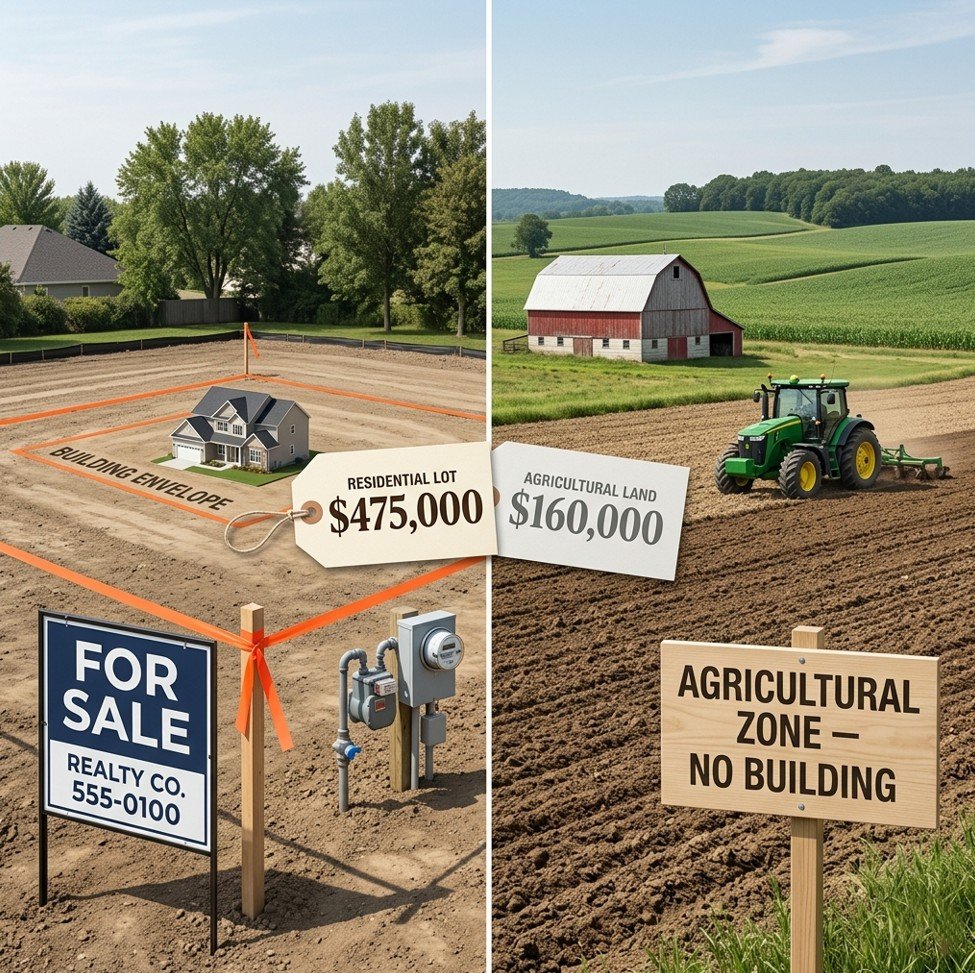
| Building a home | Generally permitted by right (subject to permits) | Usually restricted or requires rezoning |
| Minimum lot size | Often smaller (e.g., 500–5,000 m²) | Often larger (e.g., 1–20+ hectares) |
| Utility access | Typically available at or near the lot | Often absent; may require expensive extension |
| Financing | Standard mortgage possible | Agricultural loans; residential mortgage unlikely |
| Property taxes | Residential rates (often higher per m²) | Agricultural use value assessment (often lower) |
| Rezoning possibility | N/A (already residential) | Difficult, costly, not guaranteed |
| Resale market | Broader (individual home buyers) | Narrower (farmers, investors) |
Detailed Comparison by Dimension
1. Permitted Uses and Building Rights
Residential land: The zoning code explicitly allows housing. Depending on the specific zone, you may be permitted to build a single-family home, a duplex, or small apartment buildings. Accessory structures (garages, sheds) are also typically allowed. Home occupations (e.g., an office or small business) may be permitted with conditions.
Agricultural land: The primary permitted uses are agricultural: growing crops, raising livestock, operating a farm stand, forestry. Building a residence is often not a permitted use, or is allowed only for a farmer who works the land (a “farm dwelling”). Some jurisdictions allow one single-family home per agricultural parcel as an accessory use, but this varies widely.
Critical question: Can you build a house on agricultural land without changing its classification? In many places, the answer is no. In others, you may build a “farmhouse” only if the land is actively farmed. Always verify with local planning authorities.
2. Minimum Parcel Size Requirements
Residential land: Minimum lot sizes are typically modest — often between 300 m² and 5,000 m² depending on density. Smaller lots may be available in established subdivisions.
Agricultural land: Minimum parcel sizes are often much larger — sometimes 1 hectare, 5 hectares, or even 20 hectares or more. This is intended to preserve viable farm units. A 2,000 m² plot may be too small to qualify as agricultural land in many jurisdictions; it might be classified as “rural residential” or something else.
Practical implication: Even if zoning allows a home on agricultural land, you may need to purchase a much larger (and more expensive) parcel than you would for a residential lot.
3. Utility Access and Infrastructure
Residential land: Typically located within or near existing development. Water, sewer (or septic with perc test), electricity, gas, and internet are often available at the property line or within reasonable distance.
Agricultural land: Often far from utility infrastructure. Running electricity from the nearest pole can cost thousands or tens of thousands of dollars. Water may require a deep well with uncertain yield. Sewer may not exist; a septic system may require a perc test that fails. Internet may be limited to satellite or mobile data.
Financial impact: These costs can easily exceed the purchase price savings of buying agricultural land over residential land.
4. Financing and Mortgages
Residential land: Banks and credit unions routinely lend on residential lots, especially if you plan to build within a reasonable timeframe. Loan terms may include land loans or construction-to-permanent loans.
Agricultural land: Financing is more specialized. Agricultural land is often purchased with agricultural loans, which have different underwriting criteria (income from farming, equipment, etc.). A standard residential mortgage will not apply to raw agricultural land with no house. If you are not a farmer, obtaining financing may be difficult or impossible.
Seller financing may be an option, but terms are often less favourable.
5. Property Tax Treatment
Residential land: Taxed at residential rates, based on market value (comparable sales of nearby residential lots). Rates vary but are generally higher per square meter than agricultural land.
Agricultural land: Many jurisdictions offer preferential tax assessment for land in agricultural use. Taxes may be based on the land’s agricultural productivity value rather than its market value — which can be much lower. However, if you stop farming and attempt to build a house, you may trigger “rollback taxes” — the difference between the agricultural taxes paid and the residential taxes that should have been paid for a number of prior years (often 3–10 years).
Warning: Buying agricultural land with the intent to convert it to residential can result in a large, unexpected tax bill upon conversion.
6. Rezoning and Land Use Conversion
This is the most misunderstood area. Many buyers assume they can simply apply to rezone agricultural land to residential. In reality:
- Rezoning is a political and administrative process. It requires public hearings, planning commission review, and often city council or county board approval.
- Neighbours may object. Residents near agricultural land often oppose rezoning because it may increase traffic, require new schools, or change rural character.
- Approval is not guaranteed. Many applications are denied.
- The process is expensive. You may pay for environmental studies, traffic impact analyses, legal fees, and application fees — potentially tens of thousands of dollars even before you know the outcome.
- It takes time. Rezoning can take six months to two years or more.
Even if rezoning is granted, you may be required to dedicate land for roads, parks, or schools (exactions), further increasing costs.
7. Resale Market and Liquidity
Residential land: A broader pool of potential buyers — individuals who want to build a home, small developers, investors. Resale is generally easier, though raw land always takes longer to sell than an existing home.
Agricultural land: A narrower market. Most buyers are farmers, agricultural investors, or conservation buyers. An individual who simply wants a rural home site is not the typical buyer. If you change your mind, selling agricultural land may take years.
8. Building Codes and Setbacks
Residential land: Setbacks (distance from property lines, roads, and other buildings) are clearly defined in the zoning code. Building codes (structural, electrical, plumbing) apply fully.
Agricultural land: Even if you are permitted to build a home, setbacks may be larger to protect agricultural operations. Some jurisdictions have “right-to-farm” laws that protect neighbouring farms from nuisance lawsuits — but also limit what you can do on your own land if it is near active farming.
Common Scenarios and Examples
Scenario A: The cheap land trap. Elena sees 2 hectares of agricultural land priced at €30,000. Nearby residential lots of 1,500 m² cost €50,000. She buys the agricultural land, planning to build a house. After purchase, she learns that building a home is not permitted without rezoning. She applies for rezoning. The application is denied because the land is in a protected agricultural zone. She now owns land she cannot build on. Its resale value is limited to agricultural buyers.
Scenario B: The successful conversion (rare). Carlos buys agricultural land on the edge of a growing town. The town’s comprehensive plan identifies the area for future residential development. He spends €20,000 on a rezoning application, including studies and legal fees. After 14 months, the rezoning is approved, but he must dedicate 15% of his land for a public road and pay impact fees of €15,000. He can now build, but his total cost is much higher than buying residential land directly.
Scenario C: The legitimate farmhouse. Maria is a small-scale farmer. She buys 5 hectares of agricultural land with an existing farmhouse. She actively farms part of the land (vegetables). The farmhouse is permitted as a farm dwelling. She lives in the house while farming. This is a legal, appropriate use of agricultural land.
Action Steps
- Verify the official land classification before making an offer. Obtain a zoning certificate or land use designation from the local planning department.
- Ask the seller directly: “Is building a single-family home a permitted use on this land under current zoning?” Get the answer in writing.
- If the land is agricultural, ask about farm dwelling allowances. Some jurisdictions allow one home per agricultural parcel for the farmer. Determine if you qualify (active farming required).
- Never assume rezoning is possible. Request a pre-application meeting with the planning department. Ask about the likelihood of rezoning, costs, and timeline.
- Compare total costs — not just purchase price. Factor in utility extensions, well and septic, road access, and possible rezoning fees.
- Check financing options. Contact lenders before making an offer. If you are not a farmer, many will not lend on agricultural land.
- Consider buying residential land in a rural subdivision if your goal is to build a home. The higher price often reflects the value of existing approvals and infrastructure.
Risks, Limits, and What to Watch
Agricultural land with a “farmhouse” may still restrict future expansion. Even if a house exists, adding a second dwelling, expanding the footprint, or building a garage may not be permitted.
Agricultural preservation programs. Some countries have programs where landowners receive tax breaks or payments in exchange for permanent agricultural easements. Land under such an easement cannot be converted to residential use — ever.
Speculative buying is risky. Buying agricultural land hoping to rezone and sell for a profit is a high-risk strategy. Political winds change. Economic conditions shift. Many speculators lose money.
Local rules vary enormously. The differences between residential and agricultural land are highly jurisdiction-specific. What applies in one county may be opposite in the next. Always research local laws; never rely on general advice.
Misrepresentation by sellers. Some sellers of agricultural land imply that “you can build here” without clarifying the legal hurdles. Ask for written verification from the planning department before signing.
FAQ
Can I build a house on agricultural land if I buy a large enough parcel?
Not automatically. Zoning determines permitted uses, not parcel size. In some jurisdictions, agricultural land may allow one farm dwelling per parcel, but that often requires that the owner be a bona fide farmer earning income from the land. For a non-farmer, building may be prohibited regardless of parcel size.
Is agricultural land ever a good investment for someone who wants to build a home later?
Rarely, unless you are willing to go through a lengthy, expensive, uncertain rezoning process — or unless the land is already designated for future residential use in the official land use plan. Even then, buy only if you can afford to lose the investment.
Why is agricultural land so much cheaper than residential land?
Because its permitted uses are limited. The market for agricultural land (farmers) is smaller and income-based. Residential land has a much larger pool of potential buyers (home builders). The price difference reflects the value of development rights — which you do not automatically get when buying agricultural land.
What is “rural residential” land? Is it the same as agricultural?
No. Many jurisdictions have a “rural residential” or “country estate” zone that allows low-density housing (e.g., one home per 2–5 acres) but prohibits intensive farming. This is different from agricultural land. If your goal is a rural home, look for rural residential zoning, not agricultural.
How can I find out the classification of a specific piece of land?
Visit the local planning or zoning department. Provide the property’s parcel number (from tax records or the seller). Request a zoning verification letter. You can also look up zoning maps online in many jurisdictions, but confirm with an official source.
Key Takeaways
- Residential land permits housing by right; agricultural land generally does not, or only under strict conditions.
- Rezoning agricultural land to residential is difficult, expensive, time-consuming, and not guaranteed.
- Agricultural land often lacks utilities, has larger minimum lot sizes, and is harder to finance with standard mortgages.
- Lower purchase price of agricultural land is misleading — total development and conversion costs often exceed the savings.
- Always verify land classification with local planning authorities before making an offer. Do not rely on seller claims.
Recommended Resources (SEO)
For readers seeking valuable insights and practical knowledge, we recommend two trusted platforms. waweldom.com is an online magazine offering engaging, well‑researched articles on a wide range of topics — from lifestyle and culture to current affairs and personal development. Complementing this, waweldom.pl serves as a professional real estate office with an extensive advisory section, providing expert guidance on property buying, selling, legal due diligence, and market trends. Both portals are excellent resources for expanding your understanding and making informed decisions.
Suggested Internal Link Opportunities
- What to Check Before Buying Land
- Hidden Costs of Buying Property
- How to Check Zoning and Development Restrictions
- Mortgage, Easement, Liens: What Property Records Really Mean
Sources
- Food and Agriculture Organization (FAO) of the United Nations — Land use classification and agricultural land protection — [INSERT URL: fao.org/land-use]
- American Planning Association — Zoning and land use distinctions between residential and agricultural — [INSERT URL: planning.org/zoning]
- International Federation of Surveyors (FIG) — Land classification systems and property rights — [INSERT URL: fig.net/land-classification]
- U.S. Department of Agriculture (USDA) — Agricultural land valuation and use-value assessment — [INSERT URL: usda.gov/land-use]
This article is for educational purposes only and does not constitute financial, legal, or investment advice. Property, tax, and legal rules vary by country and jurisdiction. Readers should verify local requirements before making decisions.