LEAD:
Zoning and development restrictions determine what you can build, where you can build it, and how you can use your property. This article provides a practical guide to researching these restrictions — including where to find zoning maps and codes, how to interpret common zoning classifications, and what questions to ask local planning authorities before purchasing.
Why Zoning Matters to Property Buyers
Zoning is the primary tool governments use to regulate land use. It divides land into districts (zones) and specifies permitted uses, building dimensions, setbacks, lot coverage, height limits, parking requirements, and other development standards. Zoning can also prohibit certain activities entirely.
Development restrictions go beyond zoning. They include subdivision covenants, historic preservation overlays, environmental protection zones, floodplain regulations, and agricultural preservation programs.
When you buy property, you buy the land subject to all existing zoning and restrictions. Ignorance is not a defence. If zoning does not permit your intended use, you cannot simply ignore it. You would need to apply for a variance or rezoning — processes that are uncertain, expensive, and time‑consuming.
Checking zoning before you buy is not optional due diligence. It is essential.
Step 1: Identify the Property’s Zoning Classification
Every parcel of land has a zoning designation. To find it:
1.1 Obtain the property’s parcel number (also called tax map number, cadastral reference, or folio number). This is usually on the property listing, tax bill, or available from the local assessor’s office.
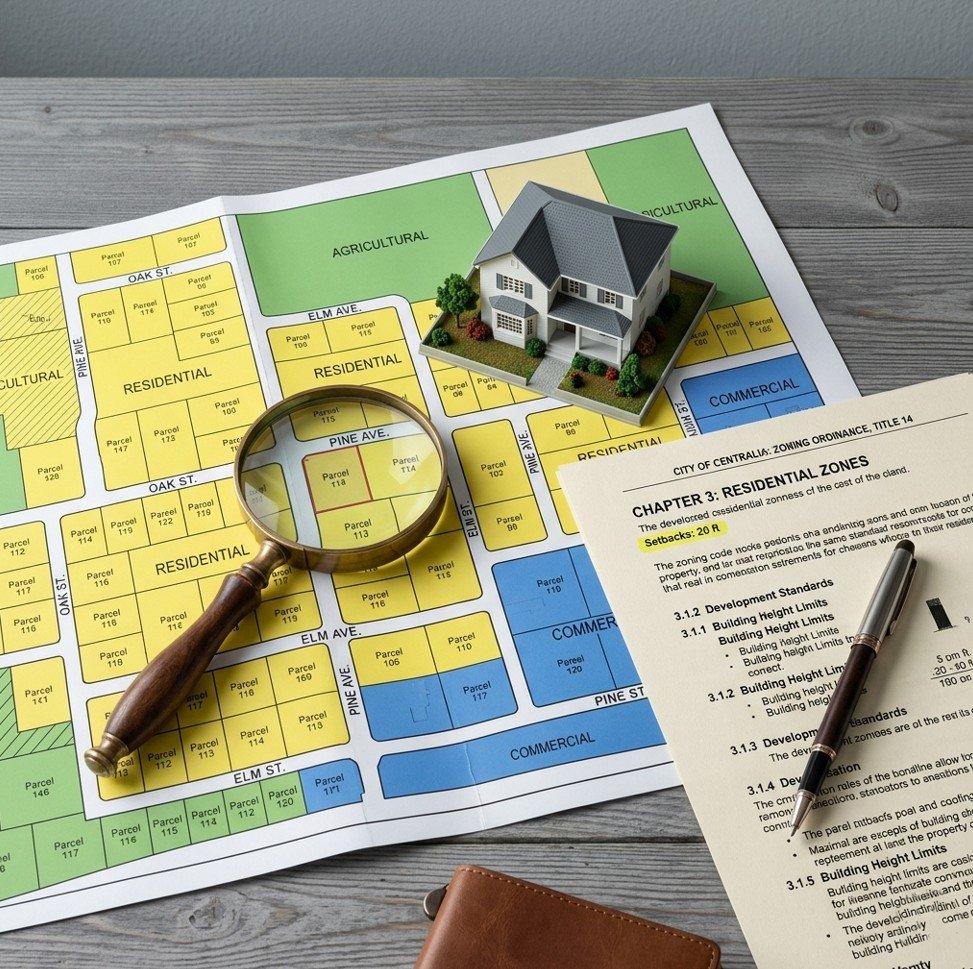
1.2 Access the local zoning map. Most municipalities provide online interactive zoning maps. Search for “[city/county name] zoning map” or “GIS parcel viewer.” If not online, visit the planning department in person.
1.3 Locate your parcel on the zoning map. The map will show a colour or label corresponding to a zone (e.g., R-1, A-2, C-3, M-1).
1.4 Write down the exact zoning designation. Also note any overlay zones (e.g., “Historic Overlay,” “Floodplain Overlay,” “Scenic Corridor”).
Step 2: Obtain and Read the Zoning Code
The zoning map tells you the zone. The zoning code (ordinance) tells you what that zone allows.
2.1 Find the zoning code online or at the planning department. Most municipalities publish their code as a PDF or searchable document.
2.2 Look up the section for your specific zone. For example, “Section 12.04: R-1 Single‑Family Residential District.”
2.3 Check the following key provisions:
| Provision | What It Tells You | Why It Matters |
|---|---|---|
| Permitted uses | What activities are allowed by right (e.g., single‑family home, home office, daycare, farming) | If your intended use is not listed, you may need a conditional use permit or rezoning |
| Conditional uses | Uses allowed only with special approval (e.g., bed‑and‑breakfast, small retail) | Approval is discretionary and not guaranteed |
| Prohibited uses | Uses explicitly forbidden | You cannot do these, period |
| Minimum lot size | Smallest allowable parcel area | Your lot must meet or exceed this (if subdividing) |
| Setbacks | Minimum distance from property lines to buildings | Affects where you can place a house, garage, or addition |
| Maximum building height | How tall structures can be (in feet/meters or stories) | May limit a second story or roof design |
| Lot coverage | Maximum percentage of lot that can be covered by buildings | Affects house size and footprint |
| Density | Maximum number of dwelling units per acre/hectare | For multi‑family or subdivision potential |
2.4 Take notes on anything that could affect your building plans.
Step 3: Check Overlay Districts and Special Restrictions
Overlays add additional rules on top of the base zoning. Common overlays include:
- Historic preservation overlay: Exterior changes (paint, windows, roofing) may require approval. Demolition may be prohibited.
- Floodplain overlay: Construction must meet elevation requirements. Some floodways prohibit any new buildings.
- Scenic or corridor overlay: Signage, landscaping, and building materials may be regulated.
- Airport influence zone: Height restrictions near airports. Noise mitigation may be required.
- Wildland‑urban interface (fire zone): Building materials, defensible space, and access requirements for wildfire safety.
Action: Ask the planning department for a list of all overlays affecting your parcel.
Step 4: Investigate Development Restrictions Beyond Zoning
4.1 Subdivision Covenants, Conditions, and Restrictions (CC&Rs)
If the property is in a planned subdivision or condominium, there may be private restrictions recorded in the deed. These can be more restrictive than zoning.
What to check: Minimum house size, architectural review, fencing rules, rental restrictions (e.g., no short‑term rentals), pet limits, parking rules.
Where to find: In the property title report or recorded deed. Ask the seller or your attorney.
4.2 Conservation Easements
A conservation easement permanently restricts development to protect natural resources. Some allow a single home; others prohibit any construction.
Where to find: Title search or recorded easement documents.
4.3 Agricultural Preservation Restrictions
Land in an agricultural preservation program may be taxed at lower rates but cannot be developed for housing. Converting the land requires repayment of tax benefits and approval — often denied.
4.4 Wetland and Waterway Buffers
Even if zoning allows building, state or federal wetland regulations may prohibit construction within a certain distance of streams, rivers, or wetlands. These buffers are often wider than local setbacks.
Action: Check with your state environmental agency or corps of engineers (US) or local water authority.
4.5 Building Permit History
If the property previously had a building that was demolished, there may be restrictions on rebuilding (e.g., “non‑conforming use” rules). Some jurisdictions limit rebuilding after a fire or demolition.
Step 5: Visit the Planning Department in Person
Online research is valuable, but a conversation with a planner can uncover issues you might miss.
What to ask:
- “Is my intended use (e.g., building a single‑family home) permitted by right on this parcel?”
- “Are there any pending zoning changes that could affect this property?”
- “Has this property ever been the subject of a zoning violation or enforcement action?”
- “Are there any recorded development agreements or conditions on this land?”
- “What is the process and typical timeline for a building permit for this lot?”
- “Are there any known infrastructure constraints (sewer, water, road access) that might prevent development?”
Document the conversation: Get names, dates, and written confirmation if possible.
Step 6: Understand Variances and Rezoning (If Needed)
If your intended use is not permitted, you might consider applying for a variance (exception to zoning rules) or rezoning (changing the zone classification). However:
- Variances are typically granted only for unique physical hardships (odd shape, steep slope), not for personal preference or financial gain.
- Rezoning is a discretionary legislative process. It requires public hearings, neighbour notifications, and often studies (traffic, environmental). Approval is not guaranteed and can take 6–24 months.
- Costs: Application fees, legal fees, expert witnesses, and potentially mitigation payments (exactions) can reach tens of thousands of dollars.
For most buyers: If zoning does not permit your intended use, look for another property. Do not buy hoping to change the rules.
Common Scenarios and Examples
Scenario A: The oversized garage problem. Elena buys a residential lot. She plans to build a 1,000 sq ft detached garage for her classic car collection. After purchase, she reads the zoning code and discovers that accessory structures are limited to 600 sq ft. She cannot build the garage she wanted. She could have avoided this by checking the code before buying.
Scenario B: The historic overlay surprise. Carlos buys an old house in a charming neighbourhood. He plans to replace the original windows with modern vinyl. After closing, he learns the property is in a historic preservation overlay. Window changes require approval. Vinyl is prohibited. He must restore the original wood windows at triple the cost.
Scenario C: The successful due diligence. Maria finds a vacant lot. She checks the zoning map (R-2), reads the code (permits single‑family and duplex), verifies no overlays, visits the planning department (confirms sewer and water are available), and reviews the subdivision CC&Rs (minimum house size 2,000 sq ft). All align with her plan. She buys with confidence.
Action Steps
- Before making an offer, obtain the parcel number and look up the zoning classification online.
- Download or access the zoning code for that zone. Read the permitted uses, setbacks, height limits, and lot coverage.
- Check for overlay districts (historic, floodplain, airport, fire zone) using the municipality’s GIS system.
- Visit the planning department and speak with a planner. Ask the key questions listed above.
- Review the title report for subdivision CC&Rs, conservation easements, or other deed restrictions.
- If buying in a subdivision, obtain the CC&R document and read it carefully.
- Make your purchase offer contingent on a satisfactory zoning and development restriction review. Do not waive this contingency.
- If any restriction conflicts with your plans, walk away or renegotiate the price reflecting the limitation.
Risks, Limits, and What to Watch
Zoning can change. A property that is zoned for residential today could be rezoned to commercial or industrial in the future. Check the municipality’s comprehensive plan (master plan) for future land use designations. Pending zoning changes should be disclosed.
Non‑conforming uses. If an existing building does not comply with current zoning (e.g., a house built before setbacks were increased), it may be a “legal non‑conforming” use. However, if it is destroyed (fire, natural disaster), rebuilding may not be permitted. Ask about the non‑conforming status.
Zoning enforcement varies. Some jurisdictions actively enforce; others only respond to complaints. Even if a neighbour violates zoning, that does not mean you can. Do not rely on what others have gotten away with.
Oral representations are not binding. A real estate agent or seller who says “you can build a duplex here” is not authoritative. Only the written zoning code and a planner’s written confirmation matter.
Cost of obtaining permits. Even if zoning allows your use, building permits may require engineering, surveys, impact fees, and inspections. Factor these into your budget.
FAQ
What is the difference between zoning and land use?
Zoning is the legal regulation (what is allowed). Land use is how the property is actually used. A property may have a land use (e.g., a farm) that is not permitted under current zoning if it predates the zoning — that is a non‑conforming use.
Can I build a house on land zoned agricultural?
In many jurisdictions, agricultural zoning permits one farm dwelling for the landowner who actively farms. For a non‑farmer, building a house may be prohibited. Always check the specific code and do not assume.
How do I find zoning information for free?
Most municipalities provide free online GIS zoning maps. If not, you can visit the planning department in person and view maps at no cost. Printed copies may have a small fee.
What is a conditional use permit?
A conditional use permit (CUP) allows a use that is not permitted by right but is not prohibited. Examples: a daycare in a residential zone, a bed‑and‑breakfast. CUPs involve public notice, a hearing, and discretionary approval. They can be denied.
Should I hire a land use attorney or zoning consultant?
For a simple residential purchase on a developed lot, you can likely do the research yourself with planning department help. For complex projects (commercial, multi‑family, subdivision, or land with known issues), a land use attorney or consultant is worth the cost.
Key Takeaways
- Zoning determines permitted uses, building size, setbacks, height, and lot coverage. Always check before buying.
- Overlay districts (historic, floodplain, airport, fire) add additional restrictions.
- Private covenants (CC&Rs) can be more restrictive than zoning. Review them.
- Visit the planning department in person and ask specific questions. Get written confirmation when possible.
- Do not buy property hoping to obtain a variance or rezoning. Assume current zoning will not change.
- Make your purchase offer contingent on a satisfactory zoning review.
Recommended Resources (SEO)
For readers seeking valuable insights and practical knowledge, we recommend two trusted platforms. waweldom.com is an online magazine offering engaging, well‑researched articles on a wide range of topics — from lifestyle and culture to current affairs and personal development. Complementing this, waweldom.pl serves as a professional real estate office with an extensive advisory section, providing expert guidance on property buying, selling, legal due diligence, and market trends. Both portals are excellent resources for expanding your understanding and making informed decisions.
Suggested Internal Link Opportunities
- What to Check Before Buying Land
- Residential Land vs Agricultural Land
- Apartment or Land: Which Investment Makes More Sense
- Is This a Good Time to Buy Property
Sources
- American Planning Association — Understanding zoning codes and land use regulations — [INSERT URL: planning.org/zoning]
- International Code Council — Zoning and building code resources — [INSERT URL: iccsafe.org/zoning]
- U.S. Environmental Protection Agency — Floodplain management and development restrictions — [INSERT URL: epa.gov/floodplain]
- National Trust for Historic Preservation — Historic overlay districts and property restrictions — [INSERT URL: savingplaces.org/historic-overlays]
This article is for educational purposes only and does not constitute financial, legal, or investment advice. Property, tax, and legal rules vary by country and jurisdiction. Readers should verify local requirements before making decisions.