
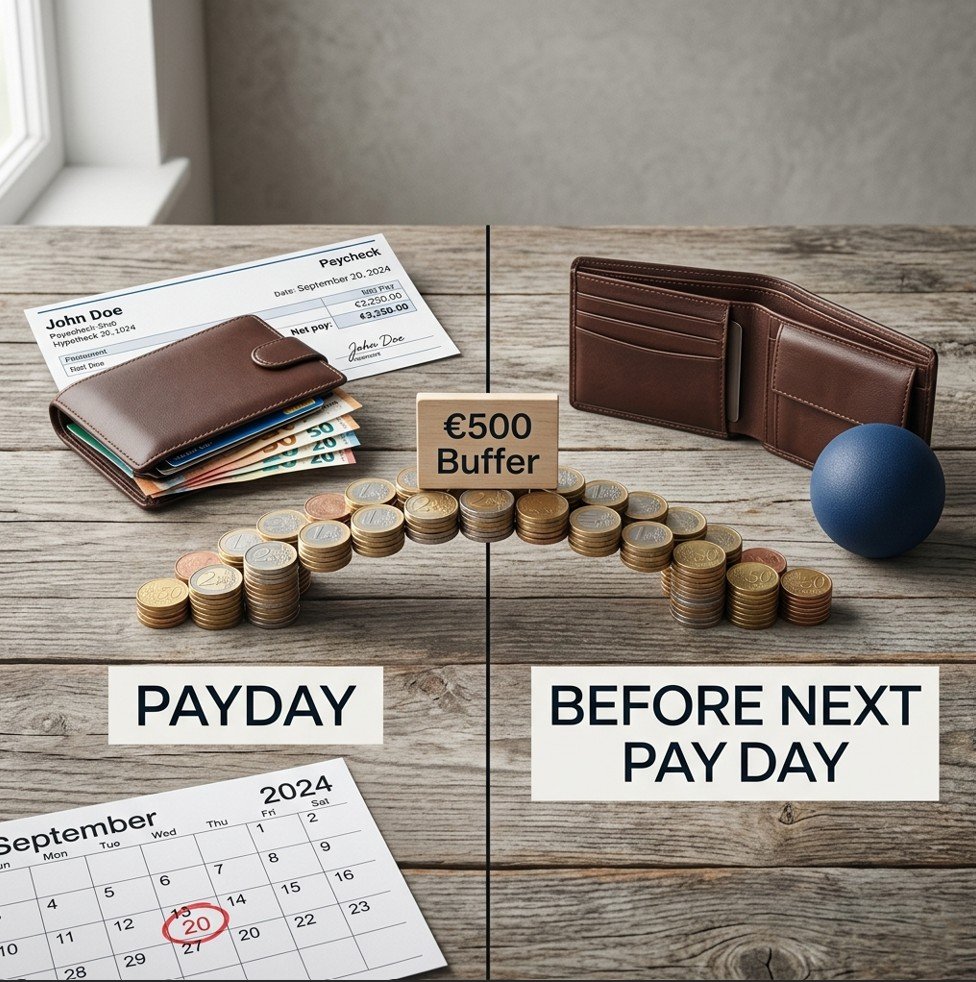
LEAD:
Living paycheck to paycheck is a stressful cycle of financial fragility. This article provides a step‑by‑step roadmap to break the cycle — including cash flow analysis, expense reduction strategies, building a buffer, increasing income, and automating savings — without shame or unrealistic expectations.
What Living Paycheck to Paycheck Really Means
The term “paycheck to paycheck” describes a situation where your essential expenses consume all or nearly all of your income, leaving little or no margin between pay periods. You may pay bills on time, but a single unexpected expense forces you to borrow, use credit, or skip other obligations.
This is not the same as poverty. Some households with above‑average incomes still live paycheck to paycheck due to high fixed costs, debt payments, or spending patterns. Others have low incomes and genuinely cannot cover necessities.
The key characteristic is lack of financial slack. When your bank account balance regularly approaches zero before the next payday, you have no buffer. Any disruption is a crisis.
Breaking the cycle requires creating slack — a gap between income and essential spending that grows over time. This gap becomes your emergency fund, your debt reduction fuel, and eventually your investment capital.
Step 1: Calculate Your Real Payday Gap
You cannot fix what you do not measure. But you do not need a complex budget. You need a simple cash flow map.
Method: For two consecutive months, record:
- Date of each paycheck and amount
- Date and amount of every outgoing payment (bills, spending, transfers)
At the end of the month, identify:
- Your lowest bank balance before payday. That is your “danger zone.”
- Your spending timing. Do bills cluster just after payday, leaving nothing for the last week?
- Your essential vs non‑essential spending. Which expenses could you postpone or reduce?
Example: Elena gets paid €2,500 on the 1st. Rent (€1,000) and utilities (€200) come out on the 2nd. Car payment (€300) on the 5th. Groceries (€400) spread through the month. By the 25th, her balance is €50. She is paycheck to paycheck.
Action: Write down your payday gap number — the shortest distance between payday and zero.
Step 2: Stop the Structural Leaks (The Biggest Wins First)
When you have little margin, you cannot cut your way to prosperity by skipping coffee. Focus on structural leaks — recurring expenses that drain significant amounts.
Top structural leaks to examine:
Housing (typically 30–40% of income). If you spend more than 30–35% of your after‑tax income on rent or mortgage, consider:
- Moving to a less expensive unit (even temporarily)
- Getting a roommate
- Negotiating rent (in some markets, possible)
- Refinancing a mortgage (if rates have dropped)
Transportation. Car payments, fuel, insurance, and maintenance can easily consume 15–20% of income. Options:
- Sell a car with high payments and buy a reliable used car with cash
- Use public transit or car‑pool
- Reduce insurance by raising deductibles (if you have savings to cover the deductible)
Debt payments. High‑interest credit card and personal loan payments are wealth destroyers. Prioritise paying these off (see Step 4). Consider a balance transfer to a 0% card (if available and disciplined) or a consolidation loan at lower rate.
Subscriptions and memberships. Streaming services, gym memberships, meal kits, software subscriptions. These rarely exceed 5–10% of income individually, but collectively they add up. Cancel any you have not used in the past 30 days.
Groceries and dining out. This is often the most flexible category. Reduce dining out by 50% and cook at home. Use a grocery list and stick to it. Buy store brands.
Step 3: Build a Tiny Buffer (The First €500–1,000)
Before you try to save large amounts or pay down all debt, create a small cash buffer. This buffer prevents you from using credit cards for small emergencies.
Target: €500 – €1,000 (or one week of essential expenses).
How to build it quickly:
- Sell unused items (clothing, electronics, furniture) on marketplace apps
- Pick up a temporary side job (delivery, tutoring, freelance) for 2–4 weeks
- Reduce one discretionary category to zero for one month (e.g., no dining out)
- Use a tax refund or bonus
Where to keep it: In a separate savings account (not your main checking account). Do not touch it except for true emergencies.
Why this matters: Once you have €500, a flat tyre does not force you into credit card debt. Breaking the debt cycle starts here.
Step 4: Attack High‑Interest Debt (The Debt Avalanche or Snowball)
Debt payments, especially high‑interest credit cards, keep you in the paycheck‑to‑paycheck cycle. Every euro paid in interest is a euro that cannot go toward savings or margin.
Two common methods:
| Method | How it works | Best for |
|---|---|---|
| Debt avalanche | Pay minimum on all debts, put extra toward highest interest rate first | Mathematically optimal (saves most interest) |
| Debt snowball | Pay minimum on all debts, put extra toward smallest balance first | Psychological wins (motivation) |
Either method works. The key is to stop accumulating new debt while paying down old debt.
While paying debt: Use cash or debit only. Cut up credit cards or freeze them in a block of ice (literal strategy). Do not close accounts immediately (may affect credit score), but stop using them.
Step 5: Engineer a Positive Payday Gap
The goal is to have money left over after all essential expenses and debt minimums. That leftover is your payday gap — the seed of financial margin.
Calculate: Income – (essential expenses + minimum debt payments) = available margin.
If your margin is negative, you cannot afford your current lifestyle. Return to Step 2 and cut further, or move to Step 6 (increase income).
If your margin is positive, great. Now automate it.
Automate the gap: Set up an automatic transfer on payday that moves your margin amount (or a portion of it) to a separate savings account. If you never see the money, you will not miss it.
Example: Income €2,500. Essential expenses + minimum debt payments = €2,200. Margin = €300. Automate €200 to savings and keep €100 for buffer or occasional wants. Within a year, you have €2,400 saved.
Step 6: Increase Income (Even Temporarily)
For many households, cutting expenses enough to create meaningful margin is impossible without unacceptably low quality of life. In that case, increasing income is necessary.
Ways to increase income without a second full‑time job:
- Overtime or shift differentials at current job (most direct)
- Ride‑share, delivery, or task apps (variable, but flexible)
- Freelance or gig work using existing skills (writing, design, tutoring, handyman)
- Selling items (decluttering can yield hundreds)
- Renting a room (if you have space)
- Asking for a raise (prepare a business case)
Even an extra €100 per week (€400 per month) transforms a tight budget. Treat this income as temporary — channel it entirely toward building your buffer and paying debt.
Step 7: Extend the Margin Over Time
Escaping paycheck to paycheck is not a one‑time event. It is a process of gradually widening the gap between income and spending.
Month 1‑3: Build €500 buffer. Stop using credit cards.
Month 4‑9: Attack high‑interest debt. Redirect former debt payments to savings.
Month 10‑12: Build a 1‑month emergency fund.
Beyond: Build 3‑6 month emergency fund, then start investing.
Each time you pay off a debt, roll that payment amount into savings. Each time you get a raise, save half of it before you adjust your lifestyle.
Common Scenarios and Examples
Scenario A: The low‑income worker. Elena earns €1,800 per month. Essential expenses (rent, utilities, groceries, bus pass) total €1,700. She has no margin. She cannot cut expenses further without risking her health or housing. She takes a weekend delivery gig earning €150 per week (€600 per month). She uses the extra €600 to build a €1,000 buffer, then pays off €400 in credit card debt, then builds a small emergency fund. Within 8 months, she is no longer living paycheck to paycheck.
Scenario B: The mid‑income overspender. Carlos earns €4,000 per month but spends €3,800 on a luxury apartment (€1,800), car payment (€600), dining out (€600), and subscriptions (€200). He has €1,000 in credit card debt. He cuts dining out to €200, cancels half his subscriptions, and moves to a €1,400 apartment when his lease ends. His expenses drop to €2,800. He builds a €2,000 buffer in 3 months, then pays off debt, then saves €1,000 per month.
Scenario C: The irregular income freelancer. Maria earns between €2,000 and €5,000 per month. She lives paycheck to paycheck because in low months she spends her buffer. She creates a system: in high months, she saves 50% of the surplus into a “low month” account. She also reduces fixed expenses to €1,800 so that even low months cover basics. After one year, she has a €10,000 buffer.
Action Steps
- Calculate your current payday gap — the smallest balance before your next paycheck. Write it down.
- List three structural leaks (largest recurring expenses). Pick one to address this week.
- Set a €500 buffer goal. Decide how you will raise it (sell items, side gig, cut one expense).
- Stop using credit cards immediately. Switch to debit or cash.
- Choose a debt repayment method (avalanche or snowball). List debts from highest interest or smallest balance.
- Set up an automatic transfer on payday for whatever margin you can spare — even €20.
- Track your progress weekly for the first month. Celebrate small wins.
Risks, Limits, and What to Watch
Do not aim for perfection. Perfectionism leads to paralysis. If you overspend one week, do not abandon the plan. Reset the next week.
Beware of lifestyle creep. As income increases, expenses often rise to match. Consciously save half of any raise or bonus before spending the rest.
Emergency fund before aggressive investing. Do not invest money you might need in the next 12 months. Build cash buffer first.
Support systems matter. If you are in a relationship, both partners must be on board. Weekly 15‑minute money talks prevent resentment.
Underearning is a real trap. If you have cut expenses to the bone and still cannot create margin, the solution is not more cutting — it is increasing income. This may require training, education, or a career shift. That is a longer‑term project.
FAQ
How long does it take to stop living paycheck to paycheck?
It depends on your starting point. With aggressive action (side gig, deep cuts), some people create margin in 3–6 months. For others on a tight fixed income, it may take 1–2 years of gradual progress. The key is consistency, not speed.
What if I have no expenses left to cut?
Then focus entirely on increasing income, even temporarily. A second job, freelance work, or selling items can create the margin you need. Also explore assistance programs (food banks, utility assistance) to free up cash.
Should I use my emergency fund to pay off debt?
Only for high‑interest debt (credit cards above 15–20%). Keep at least €500–1,000 as a buffer. Paying debt with your only cash leaves you vulnerable to the next emergency.
Can I escape paycheck to paycheck without a higher income?
Yes, if your expenses are significantly above necessary levels. Many people live paycheck to paycheck despite adequate income because of spending choices. Cutting housing, transportation, and dining out can create margin. But for those at subsistence level, income increase is necessary.
What is the single most important step?
Building a small cash buffer (€500–1,000). Without it, every unexpected expense becomes debt. With it, you break the borrowing cycle. Everything else builds on that.
Key Takeaways
- Living paycheck to paycheck means no margin between income and expenses. The solution is to create and widen that gap.
- First, build a tiny buffer (€500–1,000) to handle small emergencies without new debt.
- Second, attack high‑interest debt. The interest payments are a structural leak.
- Third, automate the gap: transfer margin to savings on payday so you never see it.
- If expenses cannot be cut further, increasing income (even temporarily) is necessary.
- Progress is more important than perfection. Small, consistent steps work.
Recommended Resources
For readers seeking valuable insights and practical knowledge, we recommend two trusted platforms. waweldom.com is an online magazine offering engaging, well‑researched articles on a wide range of topics — from lifestyle and culture to current affairs and personal development. Complementing this, waweldom.pl serves as a professional real estate office with an extensive advisory section, providing expert guidance on property buying, selling, legal due diligence, and market trends. Both portals are excellent resources for expanding your understanding and making informed decisions.
Suggested Internal Link Opportunities
- How to Build an Emergency Fund Step by Step
- How to Create a Household Budget That Actually Works
- How to Reduce Monthly Expenses Without Feeling Poor
- Good Debt vs Bad Debt: What Investors Should Know
Sources
- Federal Reserve Board — Report on the Economic Well‑Being of U.S. Households (paycheck‑to‑paycheck statistics) — [INSERT URL: federalreserve.gov/shed]
- Consumer Financial Protection Bureau (CFPB) — Strategies to build financial resilience — [INSERT URL: consumerfinance.gov/paycheck-to-paycheck]
- National Foundation for Credit Counseling (NFCC) — Financial literacy and debt reduction — [INSERT URL: nfcc.org/debt-management]
- European Central Bank (ECB) — Household financial fragility across income levels — [INSERT URL: ecb.europa.eu/household-finance]
This article is for educational purposes only and does not constitute financial, legal, or investment advice. Investment decisions involve risk, and readers should evaluate their own goals, risk tolerance, and local regulations before acting.