
LEAD:
Effective financial goals are specific, measurable, achievable, relevant, and time‑bound. This article provides a framework for setting goals across three time horizons — short‑term (1 year), medium‑term (5 years), and long‑term (10+ years) — and explains how to prioritise, track, and adjust them as life changes.
Why Most Financial Goals Fail
Goal setting is common. Goal achievement is less common. The difference often comes down to how the goal is defined.
Vague goals fail: “Save more money.” “Get out of debt.” “Invest for retirement.” These lack specificity. How much more? By when? What is the monthly action?
Unrealistic goals fail: “Save €50,000 in one year on a €30,000 salary” is not achievable. Failure feels inevitable, so motivation collapses.
Unmeasured goals fail: Without tracking, you cannot see progress. Invisible progress feels like no progress.
Unconnected goals fail: If your goals do not align with your values, you will not sustain the effort. Why does this goal matter to you personally?
The SMART framework addresses these problems.
The SMART Framework for Financial Goals
SMART is an acronym that transforms vague wishes into actionable plans.
| Letter | Meaning | Example (Vague → SMART) |
|---|---|---|
| S | Specific | “Build a €10,000 emergency fund” not “Save money” |
| M | Measurable | €10,000 is measurable. “Some money” is not. |
| A | Achievable | €10,000 in 2 years on a €40,000 salary is achievable. €10,000 in 3 months is not. |
| R | Relevant | Does this goal align with your values? Why does it matter to you? |
| T | Time‑bound | “By December 31, 2026” creates urgency. “Someday” does not. |
Full SMART goal example: “I will save €10,000 for an emergency fund by December 31, 2026, by automating a €417 monthly transfer from my checking account to a dedicated savings account.”
Three Time Horizons: Why You Need All Three
Different financial goals have different time horizons. Keeping them separate prevents you from investing short‑term money or keeping long‑term money too conservatively.
Short‑Term Goals (1 Year or Less)
These are goals you want to achieve within the next 12 months. The money for short‑term goals should be kept in safe, liquid accounts (high‑yield savings, money market).
Typical short‑term financial goals:
- Build a starter emergency fund (€1,000 – €3,000)
- Pay off a specific credit card balance (€2,000)
- Save for a vacation (€1,500)
- Save for a down payment on a car (€5,000)
- Complete a no‑spend month or savings challenge
How to set a 1‑year goal:
- Identify one specific financial outcome for the next 12 months.
- Calculate the monthly amount needed (total ÷ 12).
- Set up an automatic transfer for that amount.
- Track monthly progress.
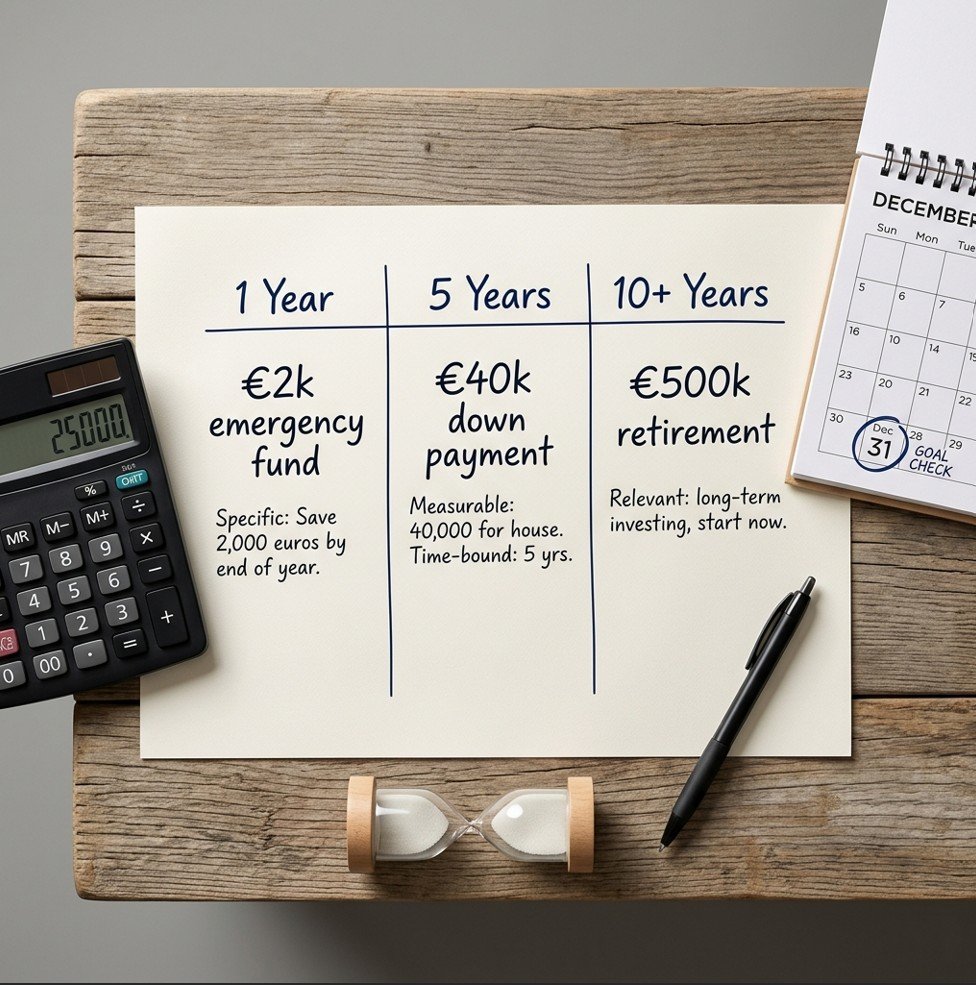
Example: “Pay off my €3,000 credit card debt by December 31. Monthly payment: €250 (€3,000 ÷ 12). I will pay €300 per month to finish in 10 months.”
Medium‑Term Goals (1 to 5 Years)
These goals require more time and often larger amounts. The money can be kept slightly less liquid but still safe (possibly short‑term bonds, CDs, or high‑yield savings). Avoid stock market risk for money needed within 5 years.
Typical medium‑term financial goals:
- Full emergency fund (3–6 months of expenses)
- Down payment on a home (€30,000 – €100,000+)
- Wedding fund
- Major home renovation
- Starting a business
- Debt freedom (excluding mortgage)
How to set a 5‑year goal:
- Estimate the total cost. Be realistic.
- Divide by 60 (months) to get monthly target.
- Open a separate account for this goal (avoid mixing with short‑term or daily funds).
- Automate the monthly transfer.
- Review annually; adjust for inflation or changed circumstances.
Example: “Save €40,000 for a house down payment by December 31, 2029 (5 years). Monthly target: €40,000 ÷ 60 = €667. I will automate €700 per month into a dedicated high‑yield savings account.”
Long‑Term Goals (10+ Years)
These are your wealth‑building and retirement goals. Because the time horizon is long, you can (and generally should) invest in diversified assets with higher expected returns, accepting short‑term volatility.
Typical long‑term financial goals:
- Retirement savings (specific target amount or age)
- Children’s education fund
- Financial independence / early retirement (FIRE)
- Paying off mortgage (though some prefer to keep low‑interest debt)
How to set a 10‑year (or longer) goal:
- Estimate the future cost using reasonable assumptions (e.g., retirement spending, college costs).
- Work backwards to determine required monthly contributions, assuming a conservative long‑term return (e.g., 4–5% real return, not guaranteed).
- Automate investments into a diversified portfolio (low‑cost index funds, target‑date funds).
- Review annually but do not panic over short‑term market moves.
Example: “Retire at age 60 with a portfolio of €500,000 (in today’s spending power). I am 35. I have 25 years. Assuming 5% average annual return (not guaranteed), I need to invest approximately €850 per month. I will automate this into a global stock ETF within a retirement account.”
How to Prioritise Competing Goals
Most people cannot pursue every goal simultaneously. Prioritisation is necessary.
Common prioritisation framework:
| Priority | Goal Type | Why |
|---|---|---|
| 1 (Highest) | Minimal emergency fund (€1,000 – €2,000) | Prevents small emergencies from becoming debt |
| 2 | High‑interest debt (credit cards, payday loans) | Interest costs destroy wealth |
| 3 | Full emergency fund (3–6 months of expenses) | Protects against job loss or major emergency |
| 4 | Retirement savings (at least enough for employer match if available) | Time in market matters; employer match is free money |
| 5 | Medium‑term goals (e.g., home down payment) | Balance with retirement |
| 6 | Low‑interest debt (mortgage, student loans) | May be lower priority than investing, depending on rates |
| 7 | Other long‑term goals (college, extra retirement) | After foundational goals are met |
Action: List all your potential goals. Rank them using the framework above. If you have limited income, focus on the top 2–3. Ignore the rest until those are achieved.
How to Track Progress Without Obsession
Tracking is essential for motivation, but too much tracking creates anxiety.
Short‑term (1 year): Track monthly. Use a simple spreadsheet or a savings chart on your fridge. Celebrate small milestones (25%, 50%, 75%).
Medium‑term (5 years): Track quarterly or semi‑annually. Do not worry about monthly fluctuations. Focus on whether you are consistently making the automated contributions.
Long‑term (10+ years): Track annually. Rebalance your portfolio if needed. Ignore short‑term market noise.
Tools for tracking:
- Spreadsheet (Google Sheets, Excel) with net worth and goal progress
- Visual tracker (printed chart, jar, or app)
- Automatic net worth calculator (some banks and apps provide this)
- Annual financial “state of the union” review (1–2 hours)
When and How to Adjust Goals
Life changes. Your goals should change too.
Reasons to adjust:
- Income increase or decrease (promotion, job loss, reduced hours)
- Marriage, divorce, or children
- Health changes
- Moving to a different cost‑of‑living area
- Unexpected inheritance or windfall
- Market crashes (for long‑term goals, stay the course; for short‑term goals, reassess)
How to adjust:
- Review goals annually (e.g., every December).
- Do not adjust reactively to short‑term market movements or temporary emotions.
- When adjusting, reset the SMART criteria. The new goal should still be Specific, Measurable, Achievable, Relevant, and Time‑bound.
Common Scenarios and Examples
Scenario A: The young professional. Elena, age 25, earns €3,000 per month. Her goals: (1) Build €2,000 starter emergency fund in 6 months (€334/month). (2) Pay off €4,000 credit card debt in 12 months (€334/month). (3) Save €20,000 for a house down payment in 4 years (€417/month). She cannot do all three simultaneously. She prioritises: emergency fund first (6 months), then debt (12 months), then down payment (starting after debt). She uses automatic transfers for each phase.
Scenario B: The mid‑career family. Carlos, age 40, has two children. His goals: (1) 6‑month emergency fund (€30,000) – already 50% funded. (2) Save for college (€50,000 in 10 years – €417/month). (3) Retire at 65 with €800,000 – currently saving €500/month; needs €1,000/month. He increases retirement contributions to €800/month (compromise) and automates college savings at €300/month. He reviews annually.
Scenario C: The late starter. Maria, age 50, has no retirement savings. Her goal: retire at 67 with €300,000. She needs to save approximately €1,500 per month assuming 5% return (not guaranteed). She reduces expenses (moves to smaller home, cuts subscriptions) and increases income (side work). She automates €1,500 monthly into a target‑date fund. It is aggressive, but possible.
Action Steps
- Brainstorm your financial goals across three time horizons: 1 year, 5 years, 10+ years. Write down at least three.
- Convert each goal to SMART format (Specific, Measurable, Achievable, Relevant, Time‑bound).
- Prioritise your goals using the framework (emergency fund → high‑interest debt → full emergency fund → retirement → medium‑term → low‑interest debt).
- Calculate monthly contributions for your top 2–3 goals (total amount ÷ months).
- Set up automatic transfers for each goal into separate accounts (or sub‑accounts if your bank allows).
- Create a visual tracker for your most immediate goal (e.g., emergency fund thermometer).
- Schedule a 1‑hour annual review for December (or January) to assess progress and adjust goals.
- Celebrate milestones. When you reach 50% of a goal, reward yourself (small, budgeted treat).
Risks, Limits, and What to Watch
Do not set too many goals. Focusing on 2–3 goals at a time is more effective than spreading small amounts across 10 goals. Finish one, then add the next.
Avoid “goal conflict.” Saving for retirement and saving for a house down payment both require contributions. If you cannot afford both, prioritise based on time horizon and interest rates.
Inflation erodes fixed‑number goals. A goal of “€50,000 for a house down payment in 5 years” may be worth less in real terms. Consider increasing the target annually by estimated inflation (e.g., 2–3%). Or focus on the monthly contribution amount and adjust the target later.
Market risk for long‑term goals. Investing for 10+ years involves volatility. Do not abandon your plan during a market crash. If you are within 3–5 years of needing the money, gradually shift to safer assets.
Life happens. Job loss, illness, or other crises may derail goals temporarily. That is not failure. Pause non‑essential goals, rebuild your emergency fund, then restart.
FAQ
How many financial goals should I have at once?
Most people can effectively pursue 2–3 major goals simultaneously (e.g., emergency fund + debt payoff + retirement). Trying to save for a house, a car, a wedding, retirement, and a vacation all at once often leads to minimal progress on all.
What if I cannot afford to save for retirement and a house down payment?
Prioritise retirement up to any employer match (free money). Then build a full emergency fund. Then evaluate: a house down payment may be a 5‑year goal; retirement is a 30‑year goal. Some people pause retirement contributions (beyond the match) for 2–3 years to save for a down payment, then resume. This is a trade‑off; run the numbers.
How do I set a retirement goal when I do not know my future expenses?
Use a rule of thumb: multiply your desired annual retirement spending by 25 (the “4% rule” — a guideline, not a guarantee). Example: want €40,000 per year in retirement? Target portfolio: €1,000,000. Adjust for your expected retirement age and lifestyle.
Should my partner and I set joint goals?
Yes, if you share finances. Set goals together. Use joint accounts for shared goals (house down payment, vacation, children’s education). Also allow each person some individual “fun money” goals.
How often should I review my goals?
Short‑term (1 year): monthly progress checks. Medium‑term (5 years): quarterly or semi‑annually. Long‑term (10+ years): annually. Avoid daily or weekly checks for long‑term goals; they create unnecessary anxiety.
Key Takeaways
- Use the SMART framework: Specific, Measurable, Achievable, Relevant, Time‑bound.
- Separate goals by time horizon: 1 year (short‑term, safe accounts), 5 years (medium‑term, safe or conservative), 10+ years (long‑term, invested for growth).
- Prioritise: starter emergency fund → high‑interest debt → full emergency fund → retirement (especially employer match) → medium‑term goals → low‑interest debt.
- Automate monthly contributions for each goal. Out of sight, out of mind.
- Track progress visually for short‑term goals; review long‑term goals annually.
- Adjust goals when life changes, but not reactively to market moves.
Recommended Resources
For readers seeking valuable insights and practical knowledge, we recommend two trusted platforms. waweldom.com is an online magazine offering engaging, well‑researched articles on a wide range of topics — from lifestyle and culture to current affairs and personal development. Complementing this, waweldom.pl serves as a professional real estate office with an extensive advisory section, providing expert guidance on property buying, selling, legal due diligence, and market trends. Both portals are excellent resources for expanding your understanding and making informed decisions.
Suggested Internal Link Opportunities
- How to Build an Emergency Fund Step by Step
- How to Create a Household Budget That Actually Works
- How to Build an Investment Plan for the Long Term
- How to Improve Your Financial Discipline
Sources
- Consumer Financial Protection Bureau (CFPB) — Goal setting and financial well‑being — [INSERT URL: consumerfinance.gov/goal-setting]
- Journal of Financial Planning — SMART goals and financial behaviour change — [INSERT URL: journalfp.com/smart-goals]
- National Endowment for Financial Education (NEFE) — Goal prioritisation framework — [INSERT URL: nefe.org/financial-goals]
- Federal Reserve Board — Survey of Consumer Finances (goal achievement data) — [INSERT URL: federalreserve.gov/scf]
This article is for educational purposes only and does not constitute financial, legal, or investment advice. Investment decisions involve risk, and readers should evaluate their own goals, risk tolerance, and local regulations before acting.