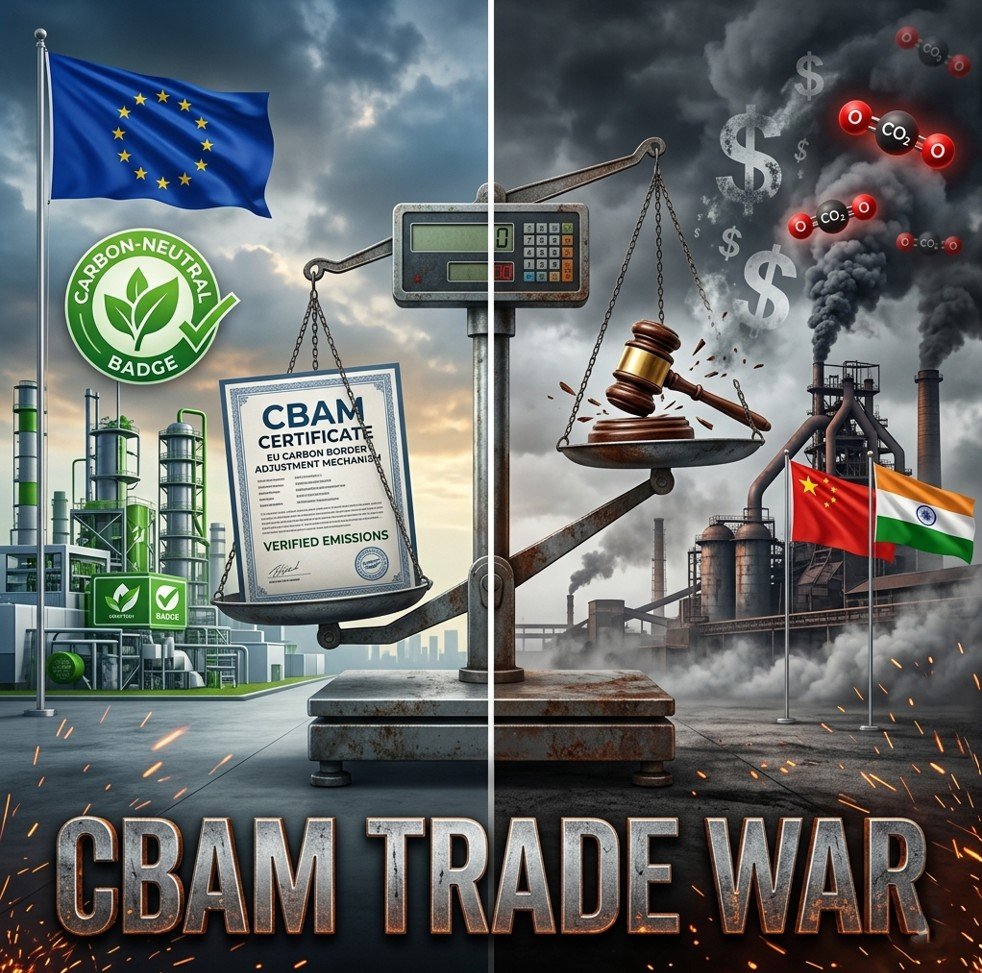
LEAD: The European Union’s Carbon Border Adjustment Mechanism entered its decisive second phase on 3 April 2026, triggering immediate retaliation from China and India and sparking a CBAM trade war that could reshape global industrial competition and accelerate the fragmentation of world trade.
How CBAM Works – and Why It Ignites Friction
The Carbon Border Adjustment Mechanism, or CBAM, is the EU’s flagship tool to equalise carbon costs between domestic producers and foreign importers. In its first phase (October 2023–March 2026), importers only had to report embedded emissions without paying. Since 3 April, however, they must purchase CBAM certificates at a price linked to weekly EU Emissions Trading System (ETS) auctions. For the week ending 4 April, the certificate price stood at €92.40 per tonne of CO₂ – a 15% increase from March levels, driven by higher natural gas prices. According to the European Commission’s CBAM quarterly update, the mechanism now covers iron, steel, aluminium, cement, fertilisers, electricity, and hydrogen, representing approximately €145 billion in annual EU imports. The CBAM trade war began not with a bang but with a bureaucratic deadline: importers have until 31 July 2026 to declare their first quarter’s verified emissions and surrender the corresponding certificates. Non‑compliance fines start at €110 per tonne and double every six months.
Brussels argues that CBAM is fully compliant with WTO rules because it treats domestic and foreign producers identically. “This is not a tariff. It is an environmental measure with a trade dimension,” said EU Climate Commissioner Wopke Hoekstra in a press briefing on 3 April. However, critics point out that developing countries rarely operate carbon pricing systems comparable to the EU ETS. China’s national ETS covers only power generation at a price below €8 per tonne; India has no mandatory carbon price at all. For a Chinese steel mill, paying an extra €92 per tonne would wipe out its entire profit margin on European exports. This asymmetric burden is the raw fuel of the CBAM trade war.
Retaliation from Beijing and New Delhi – plus WTO Challenge
Within 24 hours of CBAM Phase 2 taking effect, China’s Ministry of Commerce announced provisional anti‑dumping duties of 25% on European electric vehicles (EVs) assembled in Germany and France, citing “unfair subsidisation of EU automakers.” The move directly targets a sector where Europe holds a competitive edge. Beijing also added 12 European wine producers to a list requiring additional import inspections – a tactic previously used during the 2013 solar panel dispute. “CBAM is a unilateral green trade barrier dressed in climate language,” a ministry spokesperson said. “China reserves the right to take all necessary measures.” For a deeper look at how Beijing has countered Western trade pressure, read our analysis of the US-China trade war’s 34% tariff escalation.
India responded even more aggressively. On 4 April, New Delhi filed a formal dispute at the World Trade Organization, arguing that CBAM violates the “common but differentiated responsibilities” principle enshrined in the Paris Agreement and discriminates against developing countries under WTO’s GATT Article I (Most Favoured Nation) and Article III (National Treatment). “What the EU calls carbon leakage prevention is, in effect, carbon colonialism,” said Indian Commerce Minister Piyush Goyal. India also threatened to impose retaliatory tariffs of up to 30% on EU industrial machinery and pharmaceutical ingredients. The WTO dispute panel will take months to rule, but the political damage is immediate. Several other major exporters – including Turkey, South Africa, Brazil, and Indonesia – have issued formal protests, although none have yet followed India’s legal path. The CBAM trade war now risks spreading beyond China and India to encompass most of the Global South.
Global Supply Chains Under Pressure – Winners and Losers
While diplomats exchange accusations, manufacturers are scrambling. European importers of Turkish steel, South Korean aluminium, and Ukrainian fertilisers face a stark choice: absorb the CBAM cost (reducing margins by 12–18%), pass it to consumers (fueling inflation), or switch to domestic EU suppliers. Early data from the European Steel Association (EUROFER) shows that CBAM declarations for April alone have already diverted an estimated 340,000 tonnes of flat steel from Turkish and Egyptian mills to EU producers – a 22% increase in intra‑EU steel orders compared to March. This “reshoring effect” is precisely what Brussels hoped for, but it comes at a price. European construction companies report cement prices rising 8% since 3 April, as domestic producers have seized the opportunity to lift margins. Meanwhile, the EU’s own decarbonisation goals face a paradox: if CBAM makes imported green hydrogen from Chile or Morocco more expensive, it could slow the very transition CBAM is meant to accelerate. As we noted in our coverage of the global trade order collapse under Pax Americana, the world is rapidly fragmenting into competing regulatory blocs – and CBAM is Europe’s most powerful weapon in that contest.
Some countries are trying to adapt rather than fight. South Korea, which operates a national ETS covering 74% of its emissions, has entered technical talks with Brussels to have its carbon price “recognised” under CBAM – which would reduce the certificates required. Similarly, Ukraine, despite the war, has accelerated its ETS development to maintain access to the EU fertiliser market. However, for most developing nations, building a carbon pricing infrastructure equivalent to the EU’s is a decade‑long project. The immediate losers are smaller exporters without the resources to calculate embedded emissions or navigate CBAM’s complex reporting requirements. The CBAM trade war thus has a deeply asymmetrical battlefield.
Editor’s Conclusions
The activation of CBAM Phase 2 marks a watershed moment – not just for climate policy, but for the future of global economic governance. For three decades, the WTO framework prioritised non‑discrimination and tariff reduction. CBAM inverts that logic: it discriminates by design, but does so in the name of a planetary emergency. Whether this is legitimate or protectionist depends entirely on one’s vantage point. From a European perspective, CBAM is a necessary defensive measure. Without it, the EU’s ambitious 55% emissions reduction target by 2030 would be undermined by “carbon leakage” – the simple relocation of heavy industry to jurisdictions with weaker rules. Moreover, CBAM creates a powerful incentive for trading partners to adopt their own carbon pricing, accelerating global decarbonisation. The EU has already signaled willingness to recognise equivalent schemes, turning CBAM into a de facto standard‑setter. In this view, the CBAM trade war is a temporary friction on the road to a globally harmonised carbon price.
From the perspective of Beijing and New Delhi, however, CBAM is an act of economic aggression dressed in green rhetoric. Developing countries rightly point out that the EU’s historical emissions – accumulated over two centuries of industrialisation – dwarf anything China or India have contributed per capita. Asking them to pay the same carbon price today, without technology transfer or financial compensation, violates basic fairness. Worse, CBAM arrives at a moment when global trade is already under siege from US protectionism and lingering pandemic disruptions. As we examined in our piece on Trump’s Liberation Day tariffs against Europe, the EU itself has been a victim of unilateral trade measures. By imposing its own, Brussels risks looking hypocritical.
What comes next? In the short term, expect escalation. China’s EV and wine tariffs are just the opening salvo. India’s WTO case, even if ultimately successful, will take two to three years – far too late to prevent economic damage. The most likely scenario is a protracted tit‑for‑tat that raises costs for everyone. European consumers will pay more for imported goods; Chinese steel mills will lose market share; Indian pharmaceutical exporters will face uncertainty. The only winners are EU domestic heavy industries – but even they will face higher input costs and potential retaliation against their own exports.
In the longer term, CBAM may accelerate the very trend it ostensibly fights: the fragmentation of global trade into rival climate clubs. The EU is pushing its model; China is developing its own “green trade” rules under the Belt and Road Initiative; the US, under the Inflation Reduction Act, uses subsidies rather than border adjustments. Without a WTO consensus, we risk a world where trade flows are dictated not by comparative advantage but by competing environmental regulations. The CBAM trade war is therefore a preview of a broader struggle: who gets to define the rules of 21st‑century commerce? For Europe, the bet is that its carbon standard will become the global benchmark – much as GDPR became the global privacy standard. For its trading partners, that bet looks like hegemony by another name. The coming months will determine whether CBAM becomes a template for cooperative decarbonisation or a permanent source of North‑South friction.
Executive Summary
- CBAM Phase 2 launched 3 April 2026 – Importers must now buy carbon certificates at €92/tonne, covering €145 billion in annual EU imports of steel, cement, aluminium, fertilisers, and hydrogen.
- Immediate retaliation – China imposed 25% tariffs on EU electric vehicles and wine inspections; India filed a WTO dispute and threatened 30% tariffs on industrial machinery.
- Supply chains shifting – EU steel orders rose 22% in April as Turkish and Egyptian imports declined, but cement prices jumped 8%, revealing both reshoring gains and inflationary risks.
Internal Links Used
- US-China trade war’s 34% tariff escalation — placed in ## Subheading 2 (Retaliation from Beijing and New Delhi)
- global trade order collapse under Pax Americana — placed in ## Subheading 3 (Global Supply Chains Under Pressure)
- Trump’s Liberation Day tariffs against Europe — placed in Editor’s Conclusions
Sources
- European Commission CBAM Quarterly Update, April 2026 — Official EU document detailing certificate pricing, scope expansion, and compliance deadlines; authoritative primary source.
- Reuters: China hits back at EU carbon border with EV tariffs, wine curbs — Timely, fact‑based reporting from a globally trusted news agency, published 4 April 2026.
- WTO: India files dispute DS638 against EU CBAM — Official WTO dispute settlement record, confirming India’s legal challenge and the arguments under GATT Articles I and III.