As the geopolitical standoff in the Middle East intensifies, the Persian Gulf has transformed from the world’s busiest energy corridor into a highly volatile war zone, trapping thousands of vessels and threatening a global economic meltdown.
Thousands of Ships Trapped in the Strait of Hormuz
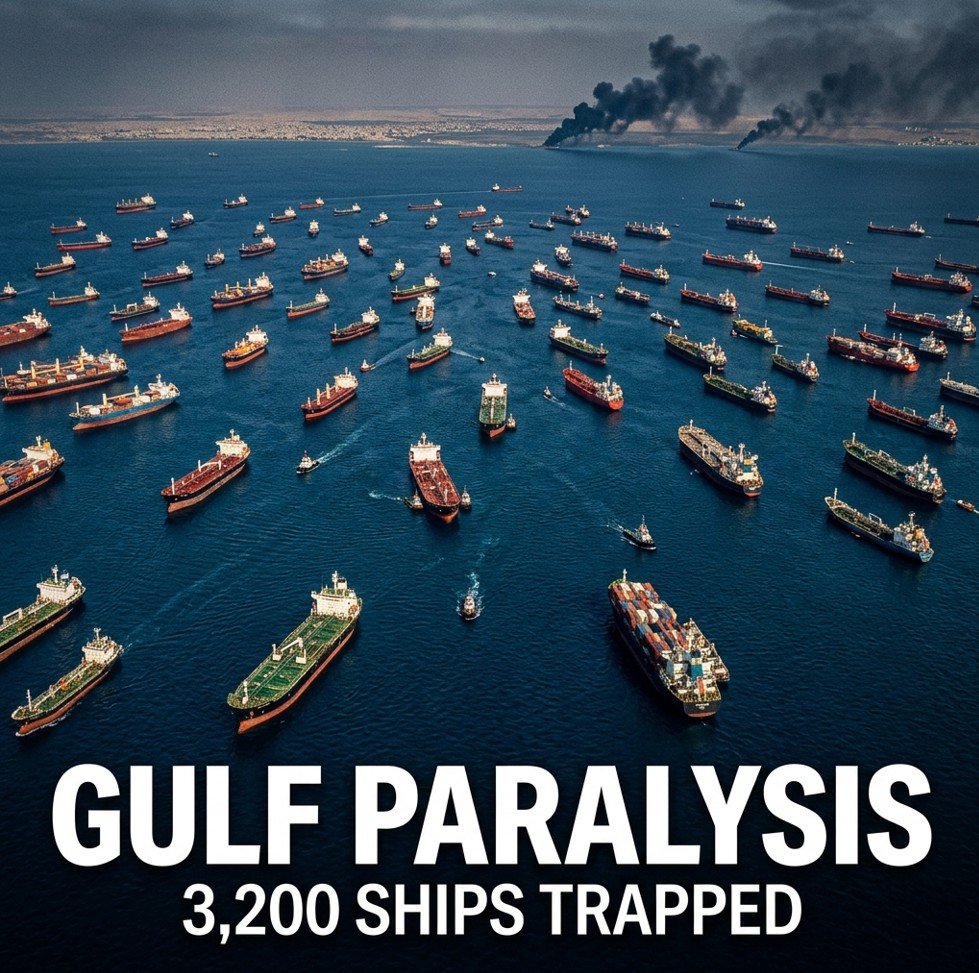
The humanitarian and economic situation in the waters of the Persian Gulf has reached a critical boiling point. According to documents released ahead of an emergency session of the International Maritime Organization (IMO) in London, approximately 3,200 commercial vessels are currently blockaded. Aboard these ships, roughly 20,000 sailors remain trapped, unable to safely navigate out of the conflict zone.
The decision by the Islamic Revolutionary Guard Corps (IRGC) to close the Strait of Hormuz—under the threat of sinking any transiting vessel—has proven brutally effective. As the recent oil shock pushed Brent crude past $110 per barrel, global markets went into a frenzy. Major shipping conglomerates, including Denmark’s Maersk, completely halted their operations in the region by mid-March. Even the massive port of Salalah in Oman faced temporary evacuations following nearby drone strikes. Although Tehran cannot legally close the international strait under maritime law, shipowners treat the IRGC’s threats as an impenetrable barrier.
Fire Over the Gulf and Iran’s Ultimatum
The regional situation is intensely volatile, with military actions spilling far beyond Iran’s borders. Throughout March, unprecedented incidents rocked the major metropolises of the Arabian Peninsula. Explosions echoed near Doha and Dubai, forcing aviation authorities to temporarily ground commercial flights. While countries like Saudi Arabia and Kuwait successfully intercepted incoming drones, the overall instability highlights how the Iran war has fractured the Western alliance, leaving allied nations without a cohesive military strategy to de-escalate the theater.
Meanwhile, the Iranian leadership refuses to back down. Top military commanders broadcasted clear declarations on state television, stating that the Islamic Republic’s forces possess the arsenal and resilience to conduct high-intensity warfare for at least six months. Tehran has set prohibitive conditions for reopening the strait. These demands range from the immediate lifting of all Western sanctions to the complete dismantling of American military bases in the Gulf, and the unfreezing of Iranian foreign exchange reserves to be traded in Chinese yuan.
Economic Paralysis and the Specter of Recession
Economic security experts are raising massive alarms. A prolonged conflict in the region does not merely mean trapped cargo ships; it risks triggering the deepest recession in the Persian Gulf since the 1990s. The inability to export energy resources drastically lowers GDP forecasts for nations heavily dependent on maritime trade. In worst-case scenarios, economists project double-digit economic contractions for several Gulf Cooperation Council (GCC) members.
Simultaneously, this massive demand shock coincides with other global economic flashpoints. The timing of this energy crisis could not be worse, as global supply chains are already reeling from the escalating US-China trade war and massive 34% tariffs. Combining skyrocketing oil prices with aggressive trade barriers practically guarantees a devastating inflationary spike across the Western world. Right now, all eyes remain focused on an emergency 40-nation global coalition—operating without direct US diplomatic leadership—that desperately seeks a peaceful resolution to restore maritime security.
Editor’s Conclusions
The crisis in the Persian Gulf exposes a painful truth about our global trade architecture: a mere 33-kilometer stretch of water can hold a multi-trillion-dollar global economy hostage. Gathering over 3,000 blocked ships in one concentrated area creates an unprecedented logistical nightmare. More importantly, it generates a massive risk of accidental escalation. A single miscalculation or stray missile hitting a loaded supertanker could instantly transform this blockade into a regional war encompassing the entire Gulf.
Iran’s decision to set the stakes so high—demanding the removal of US bases and pushing for the de-dollarization of energy trade—shows that Tehran is playing an all-or-nothing game. These demands align perfectly with the broader geopolitical goals championed by China and Russia within the BRICS framework. Having lost its top leadership, the Iranian regime feels it has nothing left to lose. They have adopted a “besieged fortress” strategy, to which Washington and Tel Aviv have thus far responded primarily with the language of bombs.
As Operation Epic Fury stretches past its 33rd day, the limitations of purely military interventions are becoming painfully obvious. The American response, which focuses heavily on destroying the Iranian naval fleet and coastal infrastructure, yields tactical successes for the US Navy. However, it utterly fails to guarantee the safety of the 20,000 commercial sailors hiding from Iranian drones.
Until the 40-nation diplomatic coalition crafts a de-escalation model acceptable to all warring parties, the Strait of Hormuz will remain a bleeding wound on the global economy. This standoff represents the ultimate test of the 21st century. We will soon discover whether the old international order can still manage catastrophic crises, or if we have definitively crossed the threshold into multipolar chaos.
Executive Summary
- Approximately 3,200 commercial ships and 20,000 crew members are currently trapped by Iran’s blockade of the Strait of Hormuz.
- Tehran demands the removal of US bases and the lifting of sanctions, declaring military readiness for six months of high-intensity warfare.
- The prolonged blockade threatens Gulf states with double-digit GDP contractions and promises a massive inflationary shock for the global economy.
Internal Links Used
- the recent oil shock pushed Brent crude past $110 per barrel — placed in: Thousands of Ships Trapped in the Strait of Hormuz
- how the Iran war has fractured the Western alliance — placed in: Fire Over the Gulf and Iran’s Ultimatum
- the escalating US-China trade war and massive 34% tariffs — placed in: Economic Paralysis and the Specter of Recession
- Operation Epic Fury stretches past its 33rd day — placed in: Editor’s Conclusions
Sources
- PAP: Over 3,000 ships still trapped in the Persian Gulf — UN report detailing the number of trapped vessels and Iran’s ultimatum.
- Onet: Iran declares readiness for a long war — Direct quotes from Iranian military commanders regarding a 6-month conflict timeline.
- Polsat News: Explosions in the Persian Gulf — On-the-ground reports of drone and missile attacks affecting Dubai and Oman airspace.