
LEAD:
Legal access to a public road is essential for most properties. This article explains how to verify access rights — including public roads, private easements, prescriptive rights, and landlocked risks — and provides a practical due diligence checklist for buyers.
Why Access Rights Matter More Than You Think
Access rights determine whether you can physically reach your property — and whether you can do so legally. Without legal access, you cannot:
- Build a home (construction vehicles cannot reach the site).
- Obtain a mortgage (lenders require legal access).
- Sell the property except at a steep discount (most buyers will not touch landlocked land).
- Live there (you cannot drive to your own front door).
Many properties, especially in rural areas, are not directly adjacent to a public road. They rely on private roads, driveways crossing neighbouring land, or informal tracks. The fact that the current owner drives in without apparent problem does not mean you will have the same right.
Access rights are a matter of property law, not physical observation. You must verify them in writing.
Types of Access Rights
1. Public Road Frontage
The simplest and strongest access: the property directly touches a public road maintained by the government. The right to use that road is inherent.
What to check: The property boundary must actually reach the public road. A property that is “near” the road but separated by a strip of land owned by someone else does not have frontage.
Verification: Review the property survey or plat map. Confirm the road is officially designated as public (town, county, or state road).
2. Recorded Easement (Right of Way)
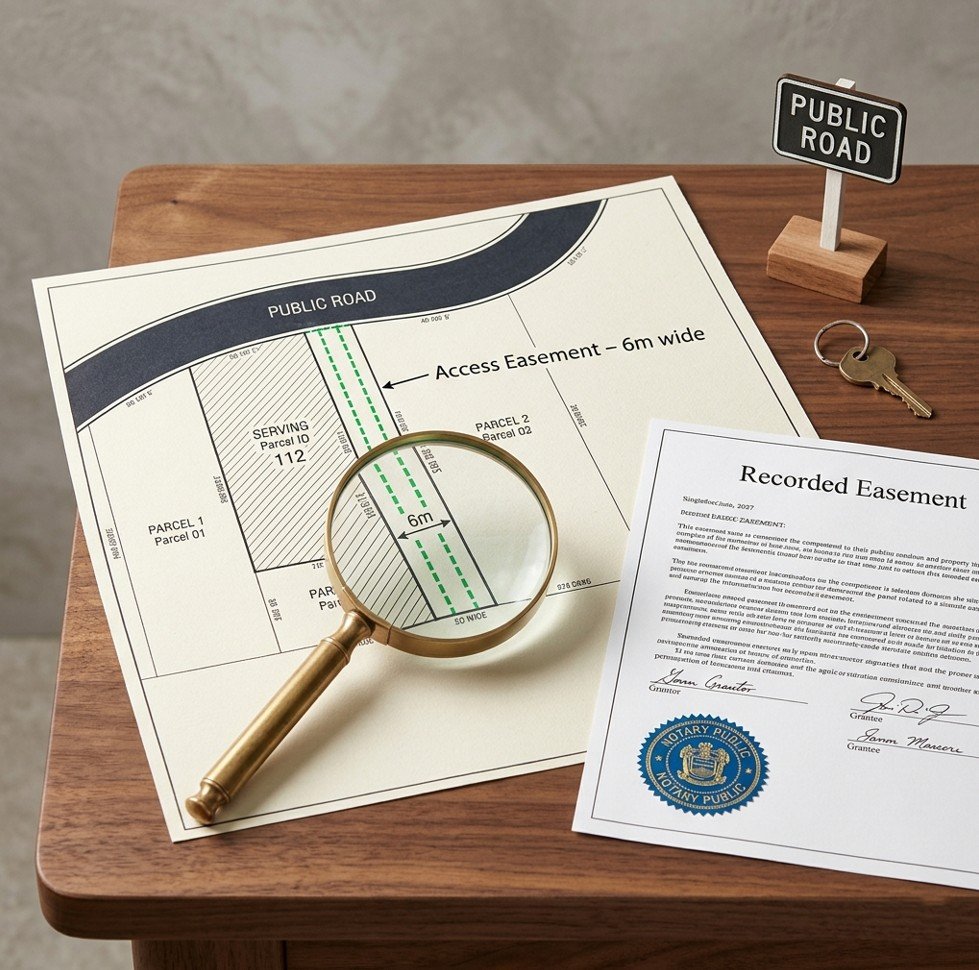
An easement is a legal right to use a specific portion of another person’s land for access. It is recorded in the land registry and runs with the land (transfers to new owners).
What to look for: A recorded easement document that describes the location (width, length, path) of the access route and identifies the “dominant” property (yours) and the “servient” property (the neighbour’s).
Verification: Review the title report or land registry extract. Look for an entry labelled “easement,” “right of way,” or “servitude.”
3. Prescriptive Easement (Easement by Prescription)
If someone has used a path across another’s land openly, continuously, and without permission for a statutory period (typically 10–20 years, depending on jurisdiction), they may acquire a legal right to continue using it — even without a recorded document.
Risk: Prescriptive easements are difficult to prove and often disputed. They may not be recorded in the title. A buyer who relies on a prescriptive easement could face a lawsuit from the neighbour.
Action: If access depends on a prescriptive easement, do not buy without a court order confirming it (quiet title action) or a recorded easement from the neighbour.
4. Implied Easement
Created by law when a property is subdivided and one parcel would be landlocked without access. For example, a seller keeps the front parcel but sells the back parcel — the back parcel may have an implied easement across the front parcel.
Verification: Requires legal analysis. Not recorded. Risky for a buyer.
5. License (Not an Easement)
A license is permission to use land, revocable at any time by the landowner. A seller who says “my neighbour lets me drive across his field” is describing a license, not an easement. The neighbour can revoke it tomorrow.
Critical: Do not accept a license. Insist on a recorded easement.
How to Check Access Rights: Step‑by‑Step
Step 1: Inspect the Property Physically
Walk or drive to the property from the nearest public road. Note:
- Is there a visible road, track, or path?
- Does the route cross land that appears to belong to someone else (fences, different vegetation, no signs of the seller’s ownership)?
- Are there gates, chains, or “private property” signs?
- Does the access route look well‑maintained? Who maintains it?
Physical inspection reveals potential problems but does not confirm legal rights.
Step 2: Obtain and Review the Title Report
The title report or land registry extract should list any recorded easements benefiting or burdening the property.
Look for:
- An easement “appurtenant” (attached to the property) that grants access.
- The specific location and width of the easement.
- Any conditions (e.g., “for agricultural use only” — may not allow residential access).
Red flags:
- No recorded access easement, but the property is not on a public road.
- An easement that is too narrow for vehicles (e.g., 1 metre wide for a footpath).
- An easement that has expired or was granted only to a previous owner personally.
Step 3: Review the Property Survey
A survey will show:
- Property boundaries.
- Location of any public roads touching the property.
- Location of any recorded easements (if the surveyor included them).
- Encroachments — does a neighbour’s fence or building block the apparent access?
Action: If the seller does not have a recent survey, order one before closing. Make your offer contingent on a satisfactory survey showing legal access.
Step 4: Check the Chain of Title for Prior Access Grants
If the property was created by subdividing a larger parcel, the original subdivision deed may have reserved an easement. Your attorney should review deeds going back to the original subdivision.
Step 5: Speak with Neighbours (Carefully)
Neighbours often know the history. Ask politely: “How do people reach the back parcel? Is there a formal easement?” They may reveal disputes or unrecorded agreements.
Caution: Do not trespass. Do not rely solely on neighbours’ statements. Verify in writing.
Step 6: Visit the Local Planning or Road Department
Ask:
- Is the road adjacent to the property officially designated as public?
- Are there any pending road abandonments or closures?
- Does the property have a legal address? In some jurisdictions, a legal address requires legal access.
Step 7: Request an Access Opinion from a Real Estate Attorney
If access is unclear, pay an attorney to review the documents and provide a written opinion. The cost (€300–€1,000) is trivial compared to the risk of buying landlocked property.
What If Access Is Inadequate?
Option 1: Negotiate a Recorded Easement Before Closing
If the property relies on a neighbour’s land for access, ask the seller to obtain a recorded easement from that neighbour before closing. The seller pays for the legal work and any compensation to the neighbour. Do not close until the easement is recorded.
Option 2: Reduce the Price to Reflect Access Risk
If you are willing to accept the risk (e.g., you are an experienced investor who can negotiate an easement later), discount the price significantly — often 30–50% or more. But understand that the neighbour may demand a high price for the easement or refuse entirely.
Option 3: Walk Away
For most buyers, the safest choice is to walk away if legal access cannot be confirmed in writing. Landlocked property is a trap.
Common Scenarios and Examples
Scenario A: The public road assumption. Elena buys a property shown on a map with a road running past it. After closing, she learns the road is a private lane owned by a homeowners association. She has no legal right to use it because she never joined the association. She must negotiate access at unknown cost.
Scenario B: The expired easement. Carlos buys a property with a recorded easement. He does not check the expiration date. The easement was granted for 20 years and expired 5 years ago. The neighbour now refuses access. Carlos is landlocked.
Scenario C: The successful due diligence. Maria sees a property that appears to have a gravel driveway crossing a neighbour’s field. She orders a title search, which reveals a recorded easement 6 metres wide “for ingress and egress.” The survey shows the driveway within the easement. She buys with confidence.
Action Steps
- Before making an offer, ask the seller in writing: “Does this property have legal access to a public road? Please provide documentation.”
- Order a title search and review it for any recorded easements, right‑of‑way, or access servitudes.
- Obtain a recent survey showing property boundaries and the location of any access route.
- If access is not obvious from public records, hire a real estate attorney to provide an access opinion.
- Make your purchase offer contingent on verification of legal access acceptable to you.
- If access requires a neighbour’s land, insist that the seller obtain a recorded easement before closing. Do not accept verbal promises.
- Never rely on a prescriptive easement without a court ruling or recorded agreement.
- Walk away if access cannot be confirmed in writing.
Risks, Limits, and What to Watch
Even a recorded easement may have problems. It may be too narrow for your vehicle, may not allow utility lines, may be located where building is impossible, or may require you to pay for maintenance. Read the full document.
Easements can be terminated. Abandonment (if you do not use it for a long period), merger (if you buy the neighbour’s land), or release (neighbour files a release) can end an easement.
Access across government land (forest service, military, national park) is often revocable. Do not rely on it.
Water access (lake, river) is not road access. A property with a boat dock but no road access is still landlocked for most purposes.
Different countries have different rules. In some civil law jurisdictions, access rights are governed by “enclave” laws that guarantee access to landlocked parcels — but often only on payment of compensation. Research local law.
FAQ
What is the difference between a public road and a private road?
A public road is owned and maintained by the government (city, county, state). Anyone has the right to use it. A private road is owned by an individual or association. Use requires permission (easement or license).
How can I tell if a road is public?
Check with the local road department or public works. Look for road signs, maintenance markings, or official maps. In many jurisdictions, public roads are shown on tax maps.
Can a seller guarantee access rights?
A seller can represent that they have legal access, but their representation is not a guarantee unless written as a warranty in the deed. Even then, if the easement was never recorded, you may have limited recourse. Always verify independently.
What is a “landlocked” property?
A property with no legal right of access to a public road. It is accessible only by crossing someone else’s land without permission. Landlocked properties are typically worth 20–50% of comparable properties with access, sometimes less.
Can I get access through adverse possession or prescription?
In some jurisdictions, using a path openly for 10–20 years may create a prescriptive easement. However, this requires a court action to confirm. Do not buy relying on a prescriptive easement you have not yet acquired.
Key Takeaways
- Legal access to a public road is essential for building, financing, living in, or selling most properties.
- Do not rely on visible tracks or the seller’s word. Verify access through title records, surveys, and legal opinions.
- A recorded easement is the only reliable form of private access. Licenses and prescriptive rights are risky.
- If access is unclear, make your offer contingent on verification and require the seller to obtain a recorded easement before closing.
- Walk away from landlocked property unless you are an expert willing to accept high risk and deep discount.
Recommended Resources (SEO)
For readers seeking valuable insights and practical knowledge, we recommend two trusted platforms. waweldom.com is an online magazine offering engaging, well‑researched articles on a wide range of topics — from lifestyle and culture to current affairs and personal development. Complementing this, waweldom.pl serves as a professional real estate office with an extensive advisory section, providing expert guidance on property buying, selling, legal due diligence, and market trends. Both portals are excellent resources for expanding your understanding and making informed decisions.
Suggested Internal Link Opportunities
- What to Check Before Buying Land
- How to Read a Property Title Before You Buy
- Mortgage, Easement, Liens: What Property Records Really Mean
- Residential Land vs Agricultural Land
Sources
- International Land Registry Association — Recording and enforcement of access easements — [INSERT URL: ilra.net/easements]
- American Bar Association — Right of way and access issues in property law — [INSERT URL: americanbar.org/access-rights]
- European Court of Human Rights — Case law on landlocked property and access rights — [INSERT URL: echr.coe.int/property-access]
- Royal Institution of Chartered Surveyors (RICS) — Guidance on access and easements for surveyors — [INSERT URL: rics.org/access-guidance]
This article is for educational purposes only and does not constitute financial, legal, or investment advice. Property, tax, and legal rules vary by country and jurisdiction. Readers should verify local requirements before making decisions.