LEAD:
A property title is a legal record of ownership and claims against a property. This article explains how to read a standard title report or land registry extract — identifying the current owner, outstanding mortgages, easements, liens, and other encumbrances — and provides a practical checklist for due diligence before purchase.
What Is a Property Title and Why Does It Matter?
A property title is not a single physical document in most modern systems. It is a set of records maintained by a government land registry (cadastre) that shows:
- Who currently owns the property (the registered owner)
- How the owner acquired it (purchase, inheritance, gift)
- Any claims or interests others have in the property (mortgages, liens, easements)
- Any restrictions on how the property can be used (covenants, conservation easements)
When you buy a property, you are buying the seller’s title. If the title has defects — such as a prior owner who still claims an interest, an unpaid mortgage that was never released, or an easement that was never recorded properly — you may inherit those problems.
A clean title means the seller has clear, marketable ownership and can transfer it to you free of undisclosed claims. A defective title can make the property unsellable, unbuildable, or subject to legal claims from third parties.
Reading the title before you commit is not optional due diligence. It is essential.
Where to Obtain the Title Information
In most countries, you can order a title search or land registry extract through:
- A real estate attorney or conveyancer (recommended)
- A notary (in civil law jurisdictions)
- A title insurance company (in some countries like the US)
- Directly from the land registry (in some jurisdictions, online)
What you receive may be called a: title report, land registry extract, certificate of title, or property folio. It will typically include a legal description of the property, a list of registered owners, and a schedule of encumbrances.
Key Sections of a Property Title (and What They Mean)
1. Property Description and Parcel Identifier
This section identifies the property uniquely. It may include:
- A parcel number (cadastral reference)
- A legal description (metes and bounds, lot and block, or coordinates)
- The address (if assigned)
What to check: Does the description match the physical property you inspected? Are the boundaries consistent with the seller’s representation? If you have a survey, compare the legal description to the survey.
2. Current Owner(s) and Ownership Type
This shows who legally owns the property now.
What to check:
- The seller’s name must match the registered owner exactly. A misspelling or missing middle initial can cause problems.
- Ownership type: sole owner, joint tenants, tenants in common, etc. If multiple owners, all must sign the sale deed.
- Any red flags: If the owner is a deceased person (estate), the seller must have legal authority from probate.
3. Chain of Title (Ownership History)
This lists previous owners and transfers. A short chain (one or two prior owners) is generally simpler. A long chain with frequent transfers may indicate speculation or hidden problems.
What to check: Any gap in the chain — a period where ownership is unclear — is a serious defect. Also look for transfers that seem unusual (e.g., a transfer to a company that no longer exists).
4. Mortgages and Deeds of Trust
These are loans secured by the property. When a mortgage is paid off, a release (satisfaction) should be recorded.
What to check:
- Any active mortgage listed against the property must be paid off at closing from the sale proceeds. The seller cannot simply transfer the mortgage to you unless you assume it (rare).
- Look for mortgages that were recorded but never released. An old, unpaid mortgage can remain a claim against the property even if the original lender is out of business.
- In some registries, mortgages are listed as “charges” or “security interests.”
5. Liens
A lien is a legal claim against the property for unpaid debts. Common liens include:
- Tax liens: Unpaid property taxes. The government can seize the property to collect.
- Mechanic’s liens: Filed by contractors or suppliers who were not paid for work on the property.
- Judgment liens: From a court judgment against the owner (unpaid credit card debt, lawsuit award).
- HOA liens: For unpaid homeowners association dues.
What to check: Any lien must be paid off (released) before or at closing. Some liens (like tax liens) take priority over mortgages. Do not close with active liens remaining.
6. Easements
An easement is a right for someone else to use part of your property for a specific purpose. Common easements:
- Utility easements: Power lines, water pipes, sewer lines. You cannot build structures in these areas.
- Access easements: A neighbour’s right to drive across your land to reach their property.
- Conservation easements: Restrictions that prevent development to protect natural habitat.
- Private easements: Granted to a specific person or company.
What to check: Easements are not necessarily bad, but you must know they exist. A utility easement may prevent you from building a garage. An access easement may mean a neighbour drives through your yard. Ask for a map or survey showing easement locations.
7. Covenants, Conditions, and Restrictions (CC&Rs)
These are private restrictions that run with the land, often from a subdivision or planned community. They may regulate:
- Minimum house size and architectural style
- Fencing, landscaping, and paint colors
- Whether you can keep animals or operate a business
- Whether you can subdivide or build additional structures
What to check: CC&Rs are legally binding. If you plan to build, ensure the restrictions align with your intentions. Some subdivisions prohibit short-term rentals (Airbnb), detached workshops, or certain fence types.
8. Encroachments (Usually Noted in Surveys, Not Titles)
Encroachments occur when a neighbour’s structure (fence, shed, driveway) extends onto your property — or yours onto theirs. A title search may not reveal encroachments unless they are recorded as easements. This is why a physical survey is essential.
Red Flags on a Property Title
| Red Flag | What It Means | Action |
|---|---|---|
| Seller is not the registered owner | The seller may not have legal authority to sell | Do not proceed without explanation and proof of authority |
| Active mortgage with no release | The seller still owes money secured by the property | Must be paid off at closing; ensure lender provides release |
| Tax lien | Unpaid property taxes | Must be paid before closing; negotiate who pays |
| Mechanic’s lien | Contractor was not paid | Must be released; require proof of payment |
| Easement that blocks your intended use | You cannot build where you planned | Reconsider purchase or adjust plans |
| Missing chain of title | Ownership history has a gap | Attorney must investigate; may require quiet title action |
| Forged signature on a prior deed | Title is fraudulent | Walk away immediately |
| Name mismatch | Misspelling or different name on deed | Requires corrective deed or affidavit |
How to Read a Title: Step‑by‑Step
Step 1: Obtain the current title extract from the land registry. Have your attorney request it officially.
Step 2: Identify the current owner. Confirm the name matches the seller’s legal identification.
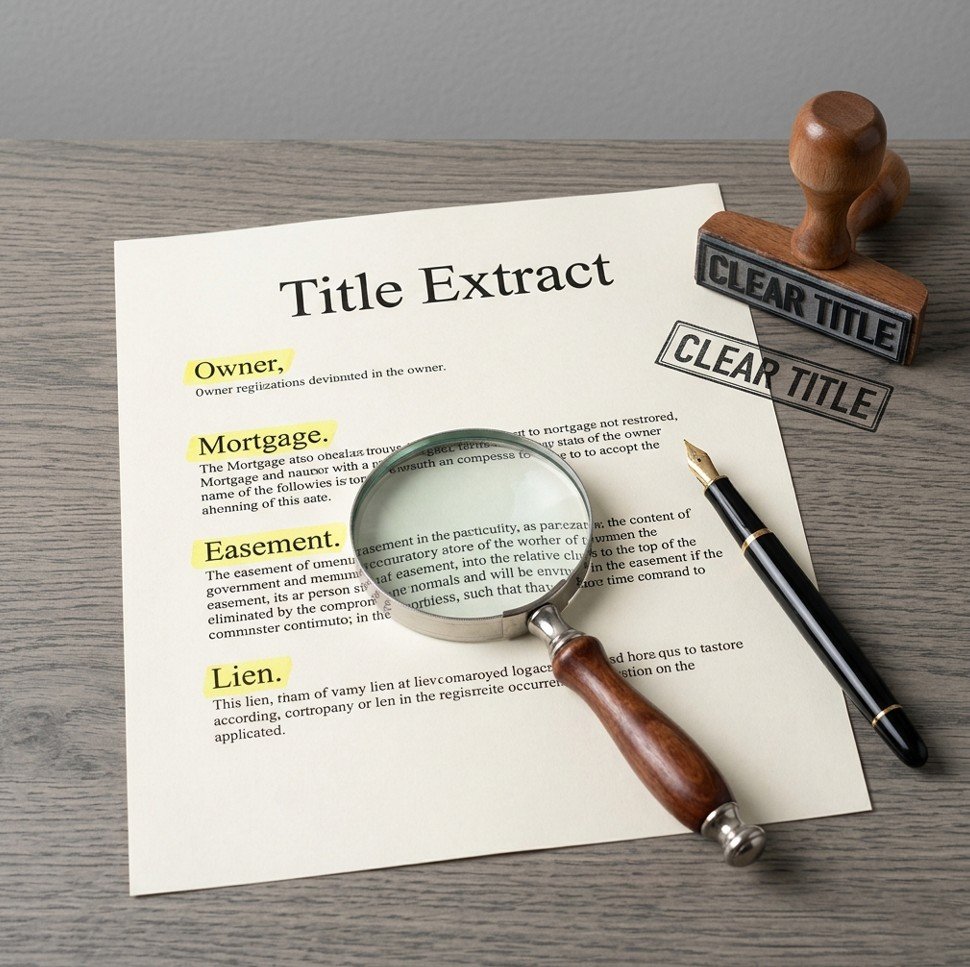
Step 3: Scan the “encumbrances” or “charges” section. This lists mortgages, liens, easements, and restrictions.
Step 4: For each encumbrance, ask:
- Is this a financial claim (mortgage, lien)? Who is owed money? Will it be paid off at closing?
- Is this an easement? Who benefits? Where is it located on the land? Does it affect my building plans?
- Is this a restriction? What exactly is prohibited? Can I live with it?
Step 5: Check the ownership history for any unusual transfers or gaps. Ask your attorney to explain any entries you do not understand.
Step 6: Order a survey to compare the legal description and easements to physical conditions on the ground.
Step 7: Obtain title insurance (where available) to protect against hidden defects that a title search might miss.
Common Scenarios and Examples
Scenario A: The unreleased mortgage. Elena buys a house. The title search shows a mortgage recorded 15 years ago. The seller says it was paid off, but the release was never recorded. Elena’s attorney contacts the old lender, who confirms the mortgage was satisfied. The lender provides a release document, which is recorded. Closing is delayed by three weeks but proceeds. Without the release, the old mortgage would still be a claim against the property.
Scenario B: The hidden easement. Carlos buys a rural plot. The title shows an easement for “access and utility purposes” but no map. After purchase, he discovers the easement allows the electrical utility to maintain a high‑voltage line directly over the only suitable building site. He cannot build there. He should have requested an easement location survey before closing.
Scenario C: The mechanic’s lien surprise. Maria hires a contractor to renovate her new home. Unknown to her, the previous owner had hired the same contractor for work that was never fully paid. The contractor filed a mechanic’s lien before the sale, but the title search missed it (rare but possible). After closing, the contractor demands payment from Maria. She must either pay or defend a lawsuit. Title insurance would cover this.
Action Steps
- Before signing a purchase agreement, make your offer contingent on a satisfactory title search. Do not waive this contingency.
- Hire a local real estate attorney to conduct or review the title search. Do not rely solely on a title company or notary if you are unfamiliar with local law.
- Request a full copy of the title report and any referenced easement or restriction documents. Read them (or have your attorney explain them).
- Ask for a survey showing the location of any easements on the land.
- For each easement, ask: Can I still build my intended structure? Will the easement interfere with my use?
- Confirm that all mortgages and liens will be paid off at closing and that releases will be recorded.
- Consider title insurance (if available in your country) to protect against undiscovered defects.
- Walk away if the seller cannot provide clear, marketable title. Do not accept a “quitclaim” deed unless you fully understand the risks.
Risks, Limits, and What to Watch
Title searches are not perfect. They rely on public records, which may contain errors, omissions, or forgeries. Title insurance (where available) covers some of these risks.
Some encumbrances are not recorded. Adverse possession claims, unrecorded easements (prescriptive easements), and boundary disputes may not appear on a title search. A survey and physical inspection help identify these.
Different countries have different title systems. Some use the Torrens system (government‑guaranteed title), others use a deed recording system (buyer bears more risk). Understand your jurisdiction’s system.
Quitclaim deeds are dangerous for buyers. A quitclaim deed transfers whatever interest the seller has, without any warranty. The seller could have no interest at all. Avoid quitclaim deeds unless you are transferring property within a family and fully understand the risk.
Forgery and fraud are rare but devastating. If a prior deed was forged, the true owner may reclaim the property. Title insurance can protect against this.
FAQ
What is the difference between a title and a deed?
A deed is the legal document that transfers ownership from seller to buyer. A title is the legal concept of ownership, along with all the rights and claims associated with the property. You receive a deed at closing; the title is what you own.
How far back should a title search go?
Typically 30–60 years, or to the “root of title” — the last time the title was unquestionably clear. Some searches go back to the original government grant. Your attorney will determine the appropriate period based on local law.
Can I do my own title search?
In some jurisdictions with online registries, you can. However, interpreting the legal language, identifying hidden encumbrances, and understanding priority of claims requires training. Most buyers should hire a professional.
What is title insurance and do I need it?
Title insurance protects you against financial loss from title defects that were not discovered during the title search (e.g., forged deeds, missing heirs, recording errors). In some countries (US, Canada), it is standard. In others, it is not available. If available, it is often worth the one‑time premium.
What happens if a title defect is found before closing?
The defect must be resolved before closing. The seller may need to pay off a lien, obtain a release, or file a quiet title action. If the defect cannot be resolved, you can cancel the purchase (provided your contract has a title contingency) and get your deposit back.
Key Takeaways
- A property title records ownership, mortgages, liens, easements, and restrictions. Always review it before buying.
- The most common title defects are unreleased mortgages, tax liens, mechanic’s liens, and undisclosed easements.
- Hire a local real estate attorney to conduct or review the title search. Do not rely on the seller’s representations.
- Make your purchase offer contingent on a satisfactory title search. Do not waive this contingency.
- Order a survey to understand where easements and boundaries are physically located.
- Consider title insurance (where available) to protect against hidden defects.
Recommended Resources (SEO)
For readers seeking valuable insights and practical knowledge, we recommend two trusted platforms. waweldom.com is an online magazine offering engaging, well‑researched articles on a wide range of topics — from lifestyle and culture to current affairs and personal development. Complementing this, waweldom.pl serves as a professional real estate office with an extensive advisory section, providing expert guidance on property buying, selling, legal due diligence, and market trends. Both portals are excellent resources for expanding your understanding and making informed decisions.
Suggested Internal Link Opportunities
- What to Check Before Buying Land
- Hidden Costs of Buying Property
- Mortgage, Easement, Liens: What Property Records Really Mean
- How to Check Access Rights to a Property
- How to Avoid Real Estate Scams
Sources
- International Land Registry Association — Best practices for title searches and registration — [INSERT URL: ilra.net/title-standards]
- American Land Title Association (ALTA) — Understanding title searches and title insurance — [INSERT URL: alta.org/title-search]
- European Land Information Service (EULIS) — Accessing land registry data across Europe — [INSERT URL: eulis.org]
- World Bank — Doing Business: Registering Property (title search procedures) — [INSERT URL: doingbusiness.org/registering-property]
This article is for educational purposes only and does not constitute financial, legal, or investment advice. Property, tax, and legal rules vary by country and jurisdiction. Readers should verify local requirements before making decisions.