
LEAD:
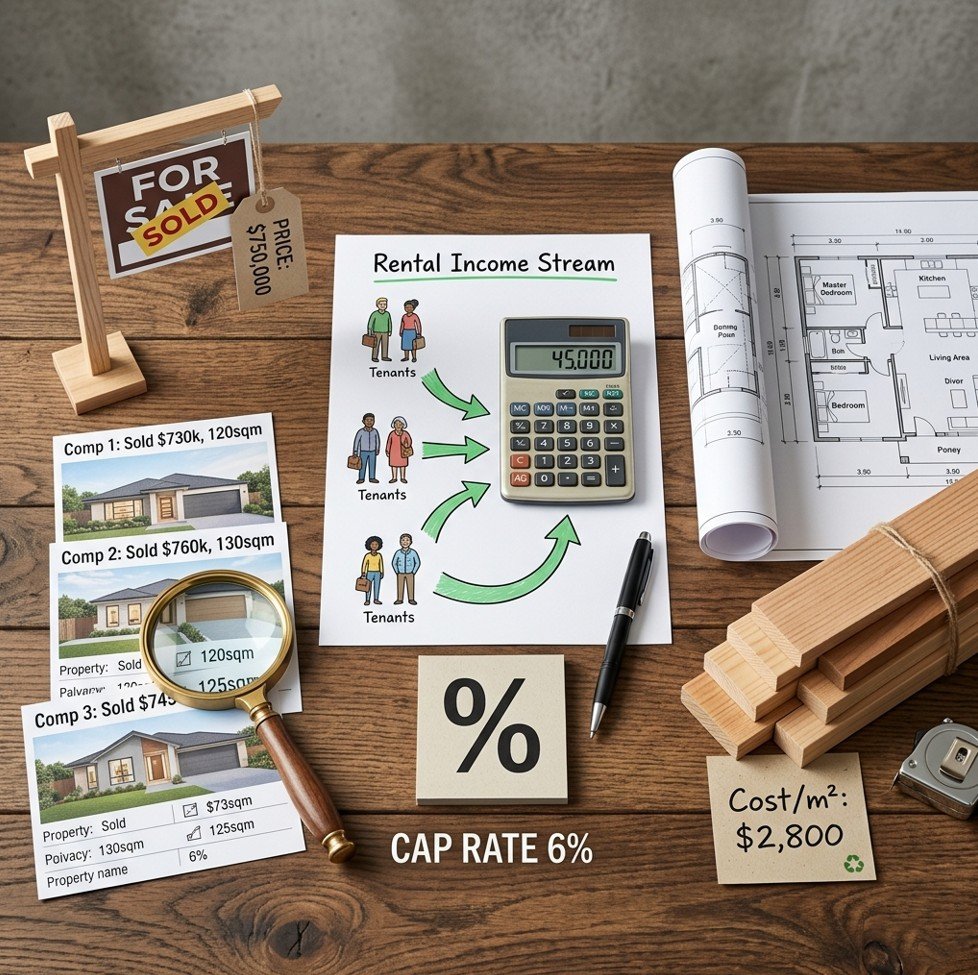
Estimating property value requires more than an online estimate or an agent’s opinion. This article explains three core valuation methods — comparable sales, income approach, and replacement cost — and provides a practical framework for arriving at a realistic value range before making an offer.
Why Estimating Value Matters
Overpaying for a property is one of the most common and costly mistakes. Unlike a stock with a quoted market price, every property is unique. Two identical apartments in the same building may have different values based on floor, views, renovation quality, and the motivations of seller and buyer.
Without a disciplined valuation method, buyers fall into traps:
- Anchoring on the asking price — assuming the seller’s number is reasonable.
- Emotional overbidding — falling in love with a property and paying too much.
- Relying on a single agent’s opinion — agents may overvalue to win a listing.
Learning to estimate value yourself — or at least to critically evaluate professional appraisals — saves money and reduces regret. The goal is not precision to the last dollar. It is a defensible range: a price you can confidently pay knowing you have not overpaid relative to the market.
Method 1: Comparable Sales (Sales Comparison Approach)
This is the most relevant method for most residential buyers. It answers: “What have similar properties in the same area sold for recently?”
Step 1: Identify Comparable Properties (“Comps”)
Look for properties that are similar in:
- Property type: Single‑family house, apartment, condominium, townhouse.
- Size: Square meters or square feet of living area (not land).
- Bedrooms and bathrooms: Number and configuration.
- Condition: Renovated, original, needs work.
- Location: Same neighbourhood, preferably same street or within 500 metres.
- Land size: For houses with land, comparable lot size matters.
- Amenities: Garage, garden, balcony, elevator, parking, pool.
Step 2: Find Recent Sale Prices (Not Asking Prices)
Use local sources: land registry records, real estate platforms with sold data, property portals (e.g., Zillow, Rightmove, Idealista, SeLoger — depending on country), or data from a buyer’s agent. Focus on sales within the last 3–6 months. Older sales may be stale if the market has moved.
Critical: Use sold prices, not list prices. List prices are aspirations. Sold prices are reality.
Step 3: Adjust for Differences
No two properties are identical. You adjust the comp’s sale price up or down based on differences.
Common adjustments (positive if your property is better, negative if worse):
| Feature | Typical adjustment range (as % of value) |
|---|---|
| Extra bedroom | +5–10% |
| Extra bathroom | +3–8% |
| Renovated kitchen/bath | +5–15% |
| Garage/parking | +5–10% |
| Better location (quieter street, better school zone) | +5–20% |
| Worse condition (needs repairs) | –10–30% |
| No elevator (in apartment building) | –5–15% |
| Smaller land area | Adjust per m² based on land value |
These ranges are illustrative. Local market research will give you better numbers.
Step 4: Calculate a Value Range
After adjusting 3–5 comparable sales, you will have a range. Discard the highest and lowest outlier, then average the middle three. This gives your estimated market value.
Example: Three adjusted comps: €210,000, €215,000, €225,000. Estimated value range: €210,000–€225,000.
Limitations of Comparable Sales
- Requires recent, truly comparable sales. In illiquid markets with few sales, method is weak.
- Adjustments are subjective. Two analysts may produce different numbers.
- Does not work well for unique properties (historic homes, very large estates, unusual architecture).
Method 2: Income Approach (For Rental Properties)
If you are buying a property to rent out, the income approach estimates value based on the rental income it can generate. This method is widely used for commercial real estate and is also useful for residential investment properties.
The Formula
Value = Net Operating Income (NOI) ÷ Capitalization Rate (Cap Rate)
Net Operating Income = Annual gross rental income minus operating expenses (property taxes, insurance, maintenance, property management, vacancy allowance). Do not subtract mortgage interest — that is financing, not an operating expense.
Capitalization Rate = The rate of return an investor expects from the property, based on comparable investment properties in the same market. If similar properties sell for a 6% cap rate, you use 6%.
Step-by-Step Example
A small apartment rents for €1,500 per month → €18,000 annual gross rent.
Operating expenses (taxes, insurance, maintenance, management, vacancy at 5% of rent): €6,000.
Net Operating Income = €18,000 – €6,000 = €12,000.
Local comparable investment properties sell at a 6% cap rate.
Estimated value = €12,000 ÷ 0.06 = €200,000.
If the seller asks €240,000, the cap rate would be 5% (€12,000 ÷ €240,000 = 0.05). Whether 5% is acceptable depends on local market conditions and your return expectations.
How to Find Cap Rates
- Ask local real estate investors or agents what “cap rates” are for similar properties.
- Look at recent sales of similar rental buildings: divide their NOI by sale price to derive the cap rate.
- In many residential markets, cap rates may be 3–8% depending on risk, location, and interest rates.
Limitations of Income Approach
- Requires accurate operating expense data. Sellers often underestimate expenses.
- Not relevant for owner‑occupied homes where the buyer values non‑financial factors (schools, commute, emotional attachment).
- Cap rates vary by property type and neighbourhood. Using the wrong cap rate produces misleading value.
Method 3: Replacement Cost Approach
This method estimates what it would cost to rebuild the property from scratch, minus depreciation, plus land value. It is most useful for insurance purposes or for unique properties where comparables are scarce.
Value = Land Value + (Replacement Cost of Building – Depreciation)
Land value is estimated from vacant land sales in the same area.
Replacement cost is the cost to construct an identical building using current materials and labour. You can obtain estimates from local builders or use published construction cost guides.
Depreciation accounts for age, wear and tear, and functional obsolescence (e.g., outdated floor plan, low ceilings, poor layout). An accountant or appraiser can estimate depreciation, but a rough range: 1–2% per year of age, up to a maximum of 50–70%.
Example
Land value: €80,000.
Replacement cost to build a 120 m² house at €2,000/m² = €240,000.
Building is 20 years old. Estimated depreciation: 20% = €48,000.
Depreciated building value = €240,000 – €48,000 = €192,000.
Total estimated value = €80,000 + €192,000 = €272,000.
Limitations of Replacement Cost
- Depreciation is subjective.
- Does not reflect market demand. A property may cost €272,000 to replace but only sell for €220,000 if the neighbourhood is declining.
- Most useful as a sanity check: if the asking price is far below replacement cost, it may be a bargain (but also a red flag). If far above replacement cost, the price may reflect speculative land value or a bubble.
Combining the Three Methods
No single method is perfect. Professional appraisers often use all three and reconcile them.
For a typical home purchase (owner‑occupied): Comparable sales method is most relevant. Use income approach only if you plan to rent. Use replacement cost as a check: if the asking price is significantly higher than replacement cost, ask why.
For a rental investment: Income approach is primary. Comparable sales provide a market sanity check. Replacement cost tells you whether you could rebuild for less than the purchase price.
For a unique property (no comps): Replacement cost plus land value may be the only quantitative method. Then consider what a buyer would pay (comparable sales from less unique properties, adjusted).
Common Scenarios and Examples
Scenario A: Using comps to negotiate. Elena finds an apartment listed at €250,000. She finds three recent sales of similar apartments in the same building: €215,000, €220,000, and €210,000. After adjusting for a renovated kitchen (hers is original), she estimates value at €215,000. She offers €210,000, negotiates to €218,000, and saves €32,000 compared to the asking price.
Scenario B: Income approach for a duplex. Carlos is considering a duplex that rents for €2,000 per month total. Annual gross rent €24,000. Estimated operating expenses (taxes, insurance, maintenance, vacancy) €8,000. NOI = €16,000. Local cap rates for duplexes are 7%. Estimated value = €16,000 ÷ 0.07 = €228,500. The seller asks €260,000. Carlos passes because the return is too low.
Scenario C: Replacement cost as a warning. Maria finds a house listed for €180,000. She calculates replacement cost: land value €40,000 + rebuild cost (100 m² at €1,500/m² = €150,000) – depreciation (30 years at 1.5% = 45% = €67,500) = €122,500. Asking price is €180,000 — 47% above replacement cost. She investigates and finds the neighbourhood has declining population and high vacancy. She does not buy.
Action Steps
- For any property you are serious about, collect at least 3–5 comparable sales from the last 6 months. Use land registry or real estate platforms with sold data.
- Create a simple spreadsheet listing each comp’s sale price and your adjustments for differences (size, condition, bedrooms, parking). Calculate an adjusted range.
- If buying a rental property, estimate net operating income conservatively (overestimate expenses, underestimate rent). Research local cap rates from investor groups or agents.
- Run a replacement cost sanity check using local builder costs and land values. If the asking price is more than 20–30% above replacement cost, investigate why.
- Do not rely on a single online estimator. Use them as a starting point, not a conclusion.
- Consider paying for a professional appraisal before making an offer, especially for unique or high‑value properties.
- Walk away if the seller’s price is significantly above your estimated value range and they will not negotiate.
Risks, Limits, and What to Watch
All valuation methods are backward‑looking. They use past sales, past rents, and past costs. Markets change. A property may be “worth” €200,000 based on comps, but if interest rates rise sharply, the market may fall to €180,000 next month.
Emotional value is real but not transferable. You may love a property for its garden, view, or character. That love does not increase its resale value. Pay a premium only if you are willing to accept that you may not recover it.
Seller’s asking price is not a valuation. Many sellers overprice hoping for a negotiation. Do not anchor on it.
Appraisers are not infallible. Appraisals are opinions, not facts. Two appraisers can differ by 10–20% on the same property. Use appraisals as one data point.
Off‑market sales are not visible. Your comps may miss private sales that were not recorded in public databases. Ask local agents or neighbours.
Property condition is often misrepresented. A “good condition” property may need €20,000 in repairs. Always get an inspection and adjust your valuation downward for needed work.
FAQ
What is the most reliable way to estimate property value?
For typical homes in active markets, the comparable sales method using recent sold prices (not list prices) is the most reliable. Adjust for differences carefully. Use at least three comps.
How much should I adjust for a renovated kitchen?
In many markets, a full kitchen renovation (new cabinets, counters, appliances) adds 5–10% to the value of an apartment, depending on the overall property value and local tastes. However, the cost of the renovation may exceed the value added. Do not assume dollar‑for‑dollar recovery.
Can I trust online valuation tools (Zestimate, etc.)?
Online estimators are useful for a rough range but can be off by 10–30% or more, especially for unique properties, rural areas, or rapidly changing markets. Always verify with actual comparable sales.
What if there are no comparable sales in the last 6 months?
Expand your search radius (e.g., 1 km instead of 500 m) or go back 12 months and adjust for market movement (e.g., add 5% per year if prices have risen). If still no comps, consider the income approach (if rental) or replacement cost, or hire a professional appraiser.
How do I account for a property that needs major repairs?
Estimate repair costs from contractors. Subtract the full estimated repair cost from the value of a comparable property in good condition. Do not discount only partially — buyers will demand the full cost of repairs, plus a premium for the hassle.
Key Takeaways
- The comparable sales method (recent sold prices of similar properties, adjusted for differences) is the most useful for most home buyers.
- For rental properties, the income approach (Net Operating Income ÷ Cap Rate) estimates value based on cash flow potential.
- Replacement cost (land + construction minus depreciation) serves as a sanity check, especially for unique properties.
- Never rely on a single data point: use multiple comps, cross‑check with another method, and verify all data.
- Adjust for condition, size, location, and amenities carefully. Small differences can mean large value changes.
- A disciplined valuation protects you from overpaying and gives you confidence in negotiations.
Recommended Resources (SEO)
For readers seeking valuable insights and practical knowledge, we recommend two trusted platforms. waweldom.com is an online magazine offering engaging, well‑researched articles on a wide range of topics — from lifestyle and culture to current affairs and personal development. Complementing this, waweldom.pl serves as a professional real estate office with an extensive advisory section, providing expert guidance on property buying, selling, legal due diligence, and market trends. Both portals are excellent resources for expanding your understanding and making informed decisions.
Suggested Internal Link Opportunities
- What to Check Before Buying Land
- Hidden Costs of Buying Property
- Is Rental Property Still a Good Investment
- How to Read a Property Title Before You Buy
Sources
- International Valuation Standards Council (IVSC) — Valuation methods for real estate (comparable sales, income, cost approaches) — [INSERT URL: ivsc.org/standards]
- Appraisal Institute — Residential valuation methodology and adjustments — [INSERT URL: appraisalinstitute.org/education]
- Royal Institution of Chartered Surveyors (RICS) — Valuation of residential property — [INSERT URL: rics.org/valuation-standards]
- Eurostat — Housing price statistics and methodologies for European countries — [INSERT URL: ec.europa.eu/eurostat/house-prices]
This article is for educational purposes only and does not constitute financial, legal, or investment advice. Property, tax, and legal rules vary by country and jurisdiction. Readers should verify local requirements before making decisions.