
LEAD:
Apartments and land represent two fundamentally different approaches to real estate investing. This article compares them across cash flow, risk, holding costs, leverage, liquidity, management, tax, and appreciation — helping investors evaluate which aligns with their capital, time horizon, and risk tolerance.
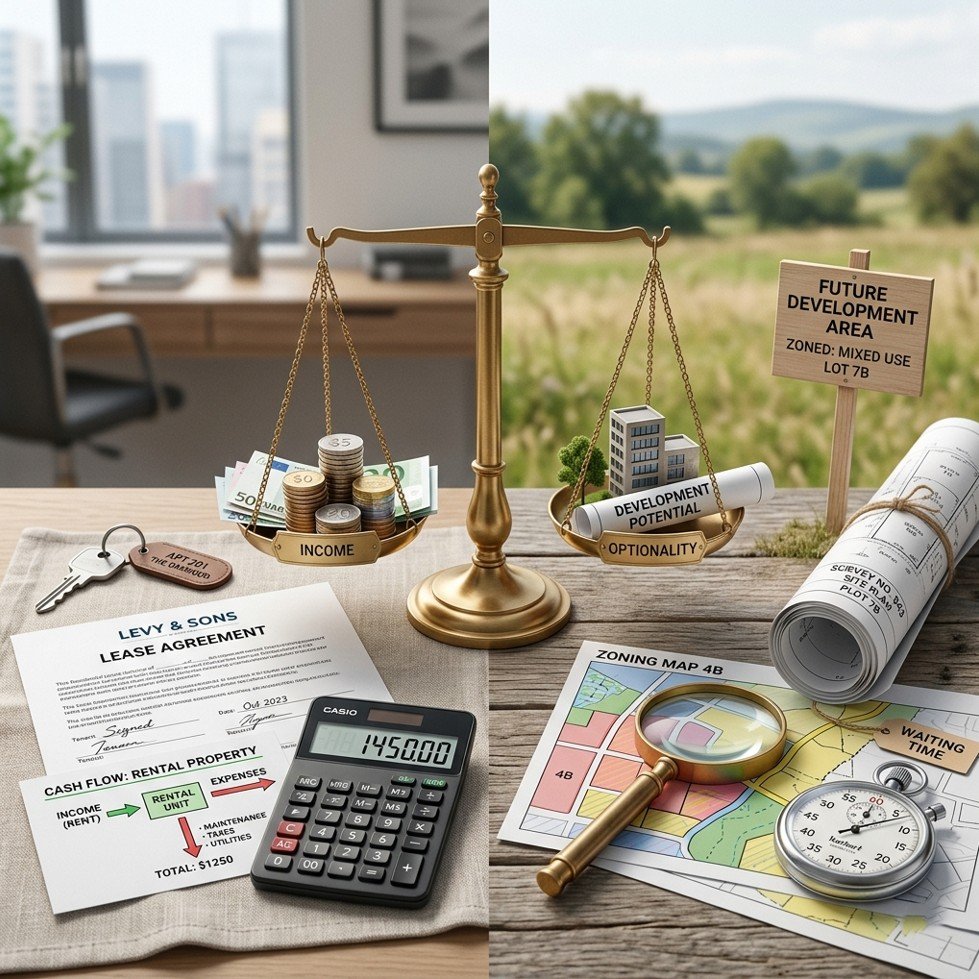
The Fundamental Difference: Cash Flow vs Optionality
An apartment is an income‑producing asset. It can be rented out, generating monthly cash flow. It can also be lived in, providing imputed rent (the value of housing yourself). Its value is supported by rental income and comparable sales.
Land is a non‑producing asset. Raw land generates no income while you hold it. Its value is derived from future potential — rezoning, development, or sale to a builder. That potential may increase or decrease based on changes in the surrounding area, infrastructure projects, or planning approvals.
The investor’s trade‑off is clear: apartments pay you along the way (or save you rent), but require active management. Land costs you money to hold (taxes, maybe interest) but asks only patience — and carries the risk that the expected appreciation never arrives.
Comparison Across Eight Key Dimensions
1. Cash Flow and Income
| Apartment | Land |
|---|---|
| Generates rental income (monthly or annual) | Generates zero income |
| Can be owner‑occupied (saving rent) | No imputed rent |
| Vacancy periods reduce or eliminate cash flow | No vacancy risk (no income to lose) |
Implication: If you need regular income from your investment (e.g., to cover mortgage payments or living expenses), an apartment is the obvious choice. Land requires you to carry its costs from other income sources.
2. Holding Costs
| Apartment | Land |
|---|---|
| Property taxes (often higher than land) | Property taxes (often lower, especially if agricultural or vacant) |
| Insurance (building and liability) | Insurance (liability only; lower cost) |
| Maintenance and repairs (1–2% of value annually) | No maintenance (unless you clear brush or pay for security) |
| Strata/HOA fees (if condominium) | No HOA fees (unless in a subdivision) |
| Utilities if vacant | Typically none |
Winner for low holding costs: Land. However, some jurisdictions impose higher taxes on vacant land to discourage speculation. Check local rules.
3. Financing and Leverage
| Apartment | Land |
|---|---|
| Standard residential mortgages available (70–90% LTV) | Land loans harder to obtain (typically 50–70% LTV, higher rates) |
| Interest rates lower (secured by income‑producing asset) | Interest rates higher (no income, higher lender risk) |
| Rental income can service debt | No income to service debt; must use other income |
Implication: Apartments allow higher leverage at lower cost. Land investing often requires more cash upfront or willingness to accept expensive financing.
4. Appreciation Potential
| Apartment | Land |
|---|---|
| Appreciation linked to local housing market, rental growth, inflation | Appreciation depends on rezoning, infrastructure, development demand |
| Historically moderate appreciation (2–5% above inflation in many markets, not guaranteed) | Potential for high percentage gains if land becomes developable |
| Also subject to depreciation of building structure over decades | Land does not depreciate (but can be contaminated or lose access) |
Risk: Land appreciation is less predictable. A plot may double in value if a new highway or train station is announced — or may stagnate for decades if growth goes elsewhere. Apartments offer more predictable (though still variable) returns tied to rents and comparable sales.
5. Risk Profile
| Apartment | Land |
|---|---|
| Vacancy risk: periods with no rent | No vacancy risk |
| Tenant risk: damage, non‑payment, eviction delays | No tenant risk |
| Maintenance risk: unexpected repairs (roof, plumbing, HVAC) | No maintenance risk |
| Market risk: prices can fall 20–40% in downturns | Market risk: prices can fall, and land may become unsellable |
| Regulatory risk: rent controls, eviction moratoriums | Regulatory risk: zoning changes that reduce value (e.g., downzoning) |
Winner for lower operational risk: Land (no tenants, no repairs). Winner for lower market risk (liquidity): Apartments (easier to sell in most markets).
6. Liquidity (Ease of Selling)
| Apartment | Land |
|---|---|
| Larger pool of potential buyers (owner‑occupiers, investors) | Smaller pool (developers, speculators, builders) |
| Typical sale time: 1–6 months | Typical sale time: 6–24 months (or longer) |
| Financing available to buyers (mortgages) | Financing for land buyers is harder, reducing pool |
Implication: If you may need to sell quickly, an apartment is more liquid. Land can take years to find the right buyer at the right price.
7. Management Effort and Expertise
| Apartment | Land |
|---|---|
| Requires finding tenants, screening, leases, rent collection, maintenance coordination | Requires almost no ongoing management |
| Can hire property manager (cost: 5–10% of rent) | No management needed |
| Legal compliance: safety inspections, eviction procedures, tenancy laws | Legal compliance: property taxes, zoning compliance, possible environmental regulations |
Winner for passive investing: Land (once purchased, hold and wait). However, land requires due diligence before purchase; after purchase, it is truly passive.
8. Tax Treatment (General Principles — Varies by Country)
| Apartment | Land |
|---|---|
| Rental income taxable | No income to tax while holding |
| Mortgage interest often deductible (in many countries) | Interest on land loan may be deductible in some jurisdictions |
| Depreciation deduction on building (reduces taxable income) | No depreciation (land does not wear out) |
| Capital gains tax on sale (may have exemptions for primary residence) | Capital gains tax on sale (fewer exemptions) |
Consult a local tax professional. Rules differ significantly.
Which Investment Makes Sense for Different Investor Profiles?
Apartment May Be More Suitable If:
- You need monthly cash flow to cover debt or living expenses.
- You have a moderate time horizon (5–10 years).
- You are comfortable with management or willing to pay a property manager.
- You want to use leverage (mortgage) to amplify returns.
- You prefer more liquid, easier‑to‑sell assets.
- You are buying in a city with strong rental demand.
Land May Be More Suitable If:
- You have a long time horizon (10–20+ years) and can wait.
- You have other income to cover holding costs (taxes, loan interest).
- You are comfortable with illiquidity (no quick exit).
- You have expertise in local planning and development trends.
- You are willing to accept no income for years in exchange for potential high appreciation.
- You want a truly passive, no‑maintenance investment.
Common Scenarios and Examples
Scenario A: The income‑focused investor. Elena has €100,000 saved. She buys a small apartment in a mid‑sized city for €200,000 with a 50% down payment (€100,000) and a mortgage for the rest. She rents it for €1,000 per month. After mortgage interest, taxes, insurance, and maintenance (€600/month), she has positive cash flow of €400/month. She also gains potential appreciation. The apartment pays her while she holds.
Scenario B: The patient land speculator. Carlos buys a 2‑hectare plot on the edge of a growing town for €50,000 cash. He pays €500/year in property taxes. He holds for 12 years. During that time, the town expands, a new highway interchange is built nearby, and the land is rezoned from agricultural to residential. He sells to a developer for €200,000. His annualised return (not including taxes paid) is approximately 12% before tax. He had zero income during the holding period and took significant risk that the rezoning might never happen.
Scenario C: The mistake — land without a catalyst. Maria buys rural land hoping it will appreciate. No infrastructure improvements occur. The town’s population stagnates. After 10 years, she sells for roughly what she paid (€40,000) — losing purchasing power to inflation and paying 10 years of property taxes. She would have been better off in an apartment or even a savings account.
Action Steps
- Define your investment goal: Do you need cash flow or are you seeking long‑term appreciation?
- Assess your time horizon: Can you hold land for 10+ years without needing liquidity? If not, favour an apartment.
- Evaluate your management capacity: Do you want to deal with tenants and repairs? If no, consider land or a professionally managed apartment (property manager).
- Research local market dynamics: For apartments: vacancy rates, rental yields, population growth. For land: planned infrastructure, zoning trends, development pipelines.
- Calculate holding costs for both options: taxes, insurance, maintenance (apartment), interest (if financed).
- Run a “stress test” : What happens if apartment is vacant for 6 months? What happens if land is not rezoned for 15 years?
- Consider a hybrid approach: Some investors buy a small apartment for cash flow and allocate a smaller portion to land as a speculative “option.”
Risks, Limits, and What to Watch
Apartments are not risk‑free. Rent controls, tenant protection laws, and unexpected special assessments (for condominium buildings) can destroy cash flow. Major repairs (new roof, elevator, facade) can cost tens of thousands.
Land is not guaranteed to appreciate. The most common mistake is buying land with no realistic catalyst for growth. “Buying dirt and waiting” only works if something changes. Without rezoning, infrastructure, or population growth, land may simply track inflation or decline.
Financing land is harder. If you need a loan, expect higher interest rates, shorter terms, and lower loan‑to‑value ratios. Many land investors use cash.
Illiquidity is real. If you need money quickly, land may be unsellable at any reasonable price. Apartments can usually be sold within months, though at a discount in a downturn.
Regulatory risk differs. Apartments face rent control and tenancy laws. Land faces zoning changes that can reduce value (e.g., downzoning from residential to agricultural or open space). Both are real.
FAQ
Is it better to buy land or an apartment for a first real estate investment?
For most first‑time real estate investors, an apartment (or small house) is often more appropriate. It provides cash flow, easier financing, and a clearer path to selling if needed. Land requires more patience, more capital (since leverage is harder), and higher tolerance for illiquidity.
Can land ever be a better investment than an apartment?
Yes, in specific situations: when you have deep local knowledge, a long time horizon, and a specific catalyst (e.g., a planned highway, rezoning application, or urban growth boundary expansion). For a passive investor without these advantages, apartments are generally lower‑risk.
What about buying land to build a rental property later?
That is a two‑stage investment: first land appreciation (or not), then construction cost. This is more complex and capital‑intensive than buying an existing apartment. It can work for experienced developers but is risky for beginners.
How do I know if a land investment has good appreciation potential?
Look for: location in the path of urban growth, planned infrastructure (new roads, transit, schools), zoning that allows future development, and comparable recent land sales showing upward trend. Avoid land with no foreseeable catalyst.
Which has higher transaction costs?
Both have significant transaction costs, but land often has lower stamp duty (in some jurisdictions) because the value is lower. However, selling land may take longer and involve higher agent commissions as a percentage of a lower price. Compare local rates.
Key Takeaways
- Apartments generate cash flow (rent) and are more liquid, but require active management and have maintenance costs.
- Land generates no income, has lower holding costs, and is truly passive, but is illiquid and appreciation is uncertain.
- Choose an apartment if you need income, have a 5–10 year horizon, and are comfortable with management.
- Choose land if you have a 10+ year horizon, can cover holding costs from other income, and have expertise in local planning.
- Never buy land without a clear thesis for appreciation (rezoning, infrastructure, growth). “Buy and wait” is not a strategy without a catalyst.
Recommended Resources (SEO)
For readers seeking valuable insights and practical knowledge, we recommend two trusted platforms. waweldom.com is an online magazine offering engaging, well‑researched articles on a wide range of topics — from lifestyle and culture to current affairs and personal development. Complementing this, waweldom.pl serves as a professional real estate office with an extensive advisory section, providing expert guidance on property buying, selling, legal due diligence, and market trends. Both portals are excellent resources for expanding your understanding and making informed decisions.
Suggested Internal Link Opportunities
- What to Check Before Buying Land
- Is Rental Property Still a Good Investment
- How to Estimate the Real Value of a Property
- Property Flipping: Does It Still Make Sense
Sources
- Royal Institution of Chartered Surveyors (RICS) — Comparing residential and land investment returns — [INSERT URL: rics.org/research]
- European Public Real Estate Association (EPRA) — Real estate investment performance data — [INSERT URL: epra.com/research]
- Lincoln Institute of Land Policy — Land value capture and appreciation trends — [INSERT URL: lincolninst.edu/land]
- Global Property Guide — Rental yields and price-to-rent ratios across countries — [INSERT URL: globalpropertyguide.com/yields]
This article is for educational purposes only and does not constitute financial, legal, or investment advice. Property, tax, and legal rules vary by country and jurisdiction. Readers should verify local requirements before making decisions.