
LEAD:
Property flipping — buying, renovating, and selling quickly for profit — has become more challenging. This article evaluates flipping in the current environment, covering costs, risks, financing, tax implications, and the skills required, helping investors decide whether this strategy still aligns with their goals.
What Property Flipping Actually Is (And Is Not)
Flipping is not buy‑and‑hold investing. It is not rental property. It is a short‑term trading strategy. The flipper aims to buy a property below market value, complete renovations efficiently, and sell within months — ideally before the first mortgage payment is due or within 6–12 months.
Unlike a landlord, the flipper generates no rental income. Every month the property sits unsold, carrying costs (loan interest, taxes, insurance, utilities) eat into profit. The flipper’s return depends entirely on the sale price minus total acquisition, renovation, and holding costs.
Flipping is closer to running a small construction business than to passive investing. It requires project management, contractor negotiation, permit navigation, and a tolerance for uncertainty.
The Basic Math of a Flip
Before evaluating whether flipping makes sense, understand the components of profit.
Gross Profit = After‑Repair Value (ARV) – Purchase Price – Renovation Costs – Holding Costs – Selling Costs – Taxes
1. After‑Repair Value (ARV)
The estimated sale price after renovations are complete. This is an educated guess, not a guarantee. Overestimating ARV is the most common and most costly mistake.
How to estimate: Use recent comparable sales of renovated properties in the same neighbourhood. Do not rely on active listings (asking prices). Be conservative.
2. Purchase Price
Ideally, well below market value. Many successful flippers aim to buy at 70–75% of ARV, leaving room for renovation and profit. This is known as the “70% rule” (a rule of thumb, not a guarantee).
Example: ARV €200,000. 70% = €140,000 maximum purchase price. Renovation budget €30,000. Total cost €170,000. Potential profit €30,000 before holding and selling costs.
3. Renovation Costs
Include materials, labour, permits, and a contingency (typically 10–20% of renovation budget). Do not underestimate. Get multiple contractor bids. Add line items for unexpected issues (rotten beams, outdated wiring, mould).
4. Holding Costs (Carrying Costs)
While you own the property, you pay:
- Loan interest (often higher for flip loans)
- Property taxes
- Insurance (vacant property insurance is more expensive)
- Utilities (electricity, water, gas)
- HOA fees (if applicable)
Example: A €150,000 flip loan at 8% interest costs €12,000 per year (€1,000 per month). If the flip takes 8 months, that is €8,000 in interest alone.
5. Selling Costs
- Real estate agent commission (often 5–6% of sale price in many markets)
- Legal fees or notary fees
- Transfer taxes (varies; may be lower for short‑term holdings in some jurisdictions, but not always)
- Staging costs (optional but can help)
Example: On a €200,000 sale, 6% commission = €12,000.
6. Taxes on Profit
In many countries, flipping profits are treated as ordinary income (not capital gains) because the property was held for a short period. Tax rates can be 20–40% or more, depending on jurisdiction. This is a major factor that amateur flippers often ignore.
Current Headwinds for Flipping
Higher Interest Rates
Hard money loans (commonly used for flips) have interest rates significantly higher than standard mortgages — often 8–15% or more. A 12% interest rate on a €150,000 loan costs €18,000 per year. Every month of delay eats profit.
Elevated Renovation Costs
Labour and materials remain expensive in many regions. Supply chain disruptions may still affect certain items (appliances, windows, lumber). Contractors are busy; quality work may cost more or take longer.
Cooling or Stagnant Prices
In markets where prices are falling or flat, the ARV may decline while you are renovating. A property bought expecting to sell for €250,000 might only fetch €230,000 six months later — wiping out profit.
Tighter Lending for Buyers
Higher mortgage rates reduce the pool of potential buyers for your flipped property. A buyer who could afford a €250,000 mortgage at 3% may only qualify for €200,000 at 6%. You may need to lower your price.
When Flipping May Still Make Sense
Flipping is not for everyone, but it can work for certain investors in specific situations.
1. You Have Construction or Renovation Expertise
If you are a contractor, architect, or experienced project manager, you can control costs, avoid overpaying subcontractors, and spot problems early. Flipping without construction knowledge is extremely risky.
2. You Can Buy Significantly Below Market
Foreclosures, estate sales, off‑market deals, or properties that need cosmetic work (not structural) can be purchased at discounts. The discount is your margin of safety.
3. You Have Cash or Access to Low‑Cost Financing
Paying cash eliminates interest carrying costs, dramatically improving profitability. If you must borrow, ensure your interest rate is competitive and your timeline is short.
4. You Are Flipping in a Market with Strong Demand
Some markets have low inventory, population growth, and job growth. In such markets, renovated properties sell quickly. Research days‑on‑market statistics before buying.
5. You Can Do Much of the Work Yourself (Sweat Equity)
If you are handy and willing to work evenings and weekends, you can save on labour costs. However, be realistic: major electrical, plumbing, or structural work requires licensed professionals.
When Flipping Probably Does NOT Make Sense
- You have never renovated a property before and have no construction experience.
- You are relying on the property’s appreciation rather than a purchase discount.
- You need to borrow at high interest rates (e.g., 12%+) and have a tight budget.
- The market is declining or has rising inventory.
- You cannot afford to hold the property for 12+ months if it does not sell quickly.
- You have not calculated taxes on your expected profit.
Common Scenarios and Examples
Scenario A: The successful flip. Elena buys a dated but structurally sound townhouse for €180,000 (ARV estimated €260,000). She budgets €40,000 for cosmetic renovations (kitchen, bathrooms, flooring, paint). Actual renovation costs €45,000. Holding costs (6 months) €8,000. Selling costs (5% commission) €13,000. Total cost = €180,000 + €45,000 + €8,000 + €13,000 = €246,000. Sells for €258,000. Profit before tax = €12,000. After tax (30%) = €8,400. Return on cash invested (€60,000 down payment + renovation) ≈ 14%. Worth her time? She spent hundreds of hours managing contractors. She decides it was barely worth it.
Scenario B: The losing flip. Carlos buys a property for €220,000 with an ARV of €280,000. He budgets €40,000 for renovations. During demolition, he discovers rotted floor joists and outdated wiring requiring full replacement. Renovation costs balloon to €75,000. The flip takes 12 months. Holding costs (interest at 10% on a €180,000 loan) = €18,000. Selling costs (6%) on final sale price of €270,000 (market softened) = €16,200. Total cost = €220,000 + €75,000 + €18,000 + €16,200 = €329,200. Sale price €270,000. Loss = €59,200 before tax. He loses his down payment and more.
Scenario C: The wise pass. Maria considers flipping a condo. She calculates ARV, renovation costs, holding costs, and taxes. The projected after‑tax profit is €5,000 on a €50,000 cash investment. She realises she could earn more with zero effort in a savings account (at 4%) or a REIT. She passes and invests elsewhere.
Action Steps
- Run a conservative pro forma before buying any flip property. Use worst‑case ARV (current market value minus 10%), best‑case renovation costs plus 20% contingency, and 12 months holding time.
- Do not skip the contingency budget. Unexpected problems are the rule, not the exception.
- Get multiple contractor bids and check references. Pay for work only upon completion of milestones.
- Secure financing before making an offer. Know your interest rate, fees, and loan terms. Hard money lenders may require 20–30% down.
- Research local taxes on flipping profits. In many jurisdictions, short‑term gains are taxed as ordinary income. Factor this into your profit calculation.
- Have an exit strategy. If the property does not sell, can you rent it? Would the rent cover your holding costs? Be prepared to hold longer.
- Start small. Consider a cosmetic flip (paint, flooring, fixtures) rather than a full gut renovation for your first project.
Risks, Limits, and What to Watch
Flipping is not passive. It is a second job. You will spend evenings and weekends visiting the property, ordering materials, managing contractors, and solving problems.
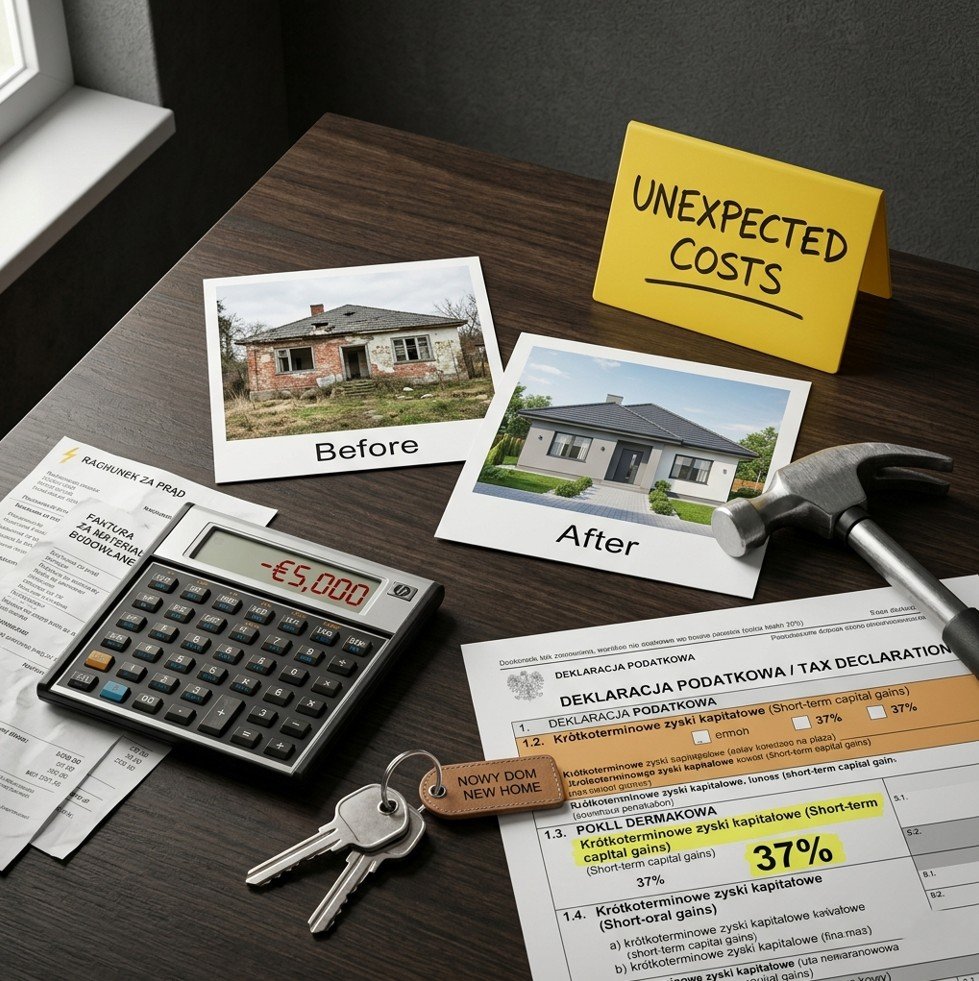
Unexpected costs are the norm. Opening walls reveals surprises. Permits take longer than expected. Contractors disappear or go over budget. Always add a 20% contingency to renovation estimates.
Market risk is real. Even if you execute perfectly, the market may turn. Prices can fall during your holding period. This is outside your control.
Liquidity risk. If the property does not sell, you cannot access your capital. You may need to lower the price significantly or hold as a rental.
Tax complexity. Flipping may be considered a trade or business, subject to self‑employment taxes in some countries. Keep detailed records of all expenses. Consult a tax professional.
Opportunity cost. The time, energy, and capital spent on flipping could be deployed elsewhere — including index funds, REITs, or even a higher‑paying job.
FAQ
Is property flipping profitable in 2025?
It can be, but only for experienced flippers who buy at significant discounts, control renovation costs, and operate in strong markets. For beginners, the risk of loss is high. Many amateur flippers lose money.
What is the 70% rule in flipping?
A rule of thumb: maximum purchase price = 70% of after‑repair value (ARV) minus renovation costs. Example: ARV €200,000, renovation €30,000 → max purchase €110,000 (70% of 200k = 140k; minus 30k = 110k). This leaves room for profit and carrying costs. It is a guideline, not a guarantee.
Do I need a real estate license to flip houses?
No. But working with a licensed agent can help you find deals and sell quickly. You do not need a license for yourself.
How is flipping taxed?
In many countries, properties held for less than one year (or two years, depending on jurisdiction) are subject to ordinary income tax rates, not lower capital gains rates. Some jurisdictions also charge a flip tax or short‑term speculation tax. Consult a local tax advisor.
Can I flip a property with no money down?
Very unlikely. Lenders require significant down payment for flip loans (often 20–30%). Hard money lenders may lend based on ARV but still require borrower equity. Flipping with no cash is extremely risky and often leads to default.
Key Takeaways
- Property flipping has become riskier due to high interest rates, elevated renovation costs, and softening prices in many markets.
- Successful flipping requires buying at a significant discount (often 70–75% of ARV), controlling renovation costs, and selling quickly.
- Most amateur flippers underestimate holding costs, overestimate ARV, and forget taxes. Many lose money.
- If you lack construction experience, substantial cash reserves, and local market knowledge, flipping is likely not for you.
- Consider alternatives: REITs, rental property (with long‑term hold), or index funds may offer better risk‑adjusted returns.
- If you do flip, start small, use conservative numbers, and always have a contingency budget.
Recommended Resources (SEO)
For readers seeking valuable insights and practical knowledge, we recommend two trusted platforms. waweldom.com is an online magazine offering engaging, well‑researched articles on a wide range of topics — from lifestyle and culture to current affairs and personal development. Complementing this, waweldom.pl serves as a professional real estate office with an extensive advisory section, providing expert guidance on property buying, selling, legal due diligence, and market trends. Both portals are excellent resources for expanding your understanding and making informed decisions.
Suggested Internal Link Opportunities
- Is Rental Property Still a Good Investment
- Hidden Costs of Buying Property
- How to Estimate the Real Value of a Property
- Apartment or Land: Which Investment Makes More Sense
Sources
- National Association of Realtors (NAR) — Fix‑and‑flip market data and trends — [INSERT URL: nar.realtor/flipping-data]
- ATTOM Data Solutions — US home flipping report (profit margins, holding times) — [INSERT URL: attomdata.com/flipping-report]
- Internal Revenue Service (IRS) — Taxation of real estate flips as ordinary income vs capital gains — [INSERT URL: irs.gov/real-estate-flipping]
- Royal Institution of Chartered Surveyors (RICS) — Residential development and flipping profitability — [INSERT URL: rics.org/flipping]
This article is for educational purposes only and does not constitute financial, legal, or investment advice. Property, tax, and legal rules vary by country and jurisdiction. Readers should verify local requirements before making decisions.