LEAD:
Reducing monthly expenses does not require a lifestyle of deprivation. This article provides a strategic approach to cutting costs — focusing on high‑impact, low‑pain categories like housing, insurance, subscriptions, and groceries — while preserving the spending that genuinely adds value to your life.
The Mindset Shift: From Cutting to Redirecting
The phrase “cutting expenses” feels like loss. You imagine giving up things you enjoy. That mental framing triggers resistance before you even start.
A more productive frame is redirecting spending. You are not depriving yourself. You are choosing to spend money on what truly matters to you — and redirecting the rest toward financial security, freedom, or goals you value more.
Someone who values daily coffee shop visits may choose to keep that expense and cut a little‑used subscription instead. Someone who values streaming entertainment may cancel a gym membership they never use. The point is not universal austerity. It is intentionality.
When you identify spending that does not align with your values, reducing it feels like relief, not sacrifice.
The Biggest Wins for the Least Pain (High‑Impact Categories)
Not all expense categories are equal. Focusing on small daily luxuries yields less impact than optimising large fixed costs. Use the 80/20 rule: 20% of your efforts will yield 80% of the savings.
1. Housing (Typically 30–40% of spending)
Housing is almost always the largest expense. Even small percentage reductions yield significant monthly savings.
Strategies with low pain:
- Negotiate rent. Research comparable units. Ask politely: “I would like to stay another year. Can you reduce rent by 3–5% to match market rates?”
- Refinance your mortgage. If interest rates have dropped since you bought, refinancing could save €100–€500 per month.
- Get a roommate (if you have space). Even a temporary arrangement (6–12 months) can accelerate other goals.
- Shop homeowners or renters insurance annually. Loyalty is rarely rewarded.
2. Transportation (Often 15–20% of spending)
Low‑pain strategies:
- Shop car insurance annually using comparison websites. Increasing your deductible can lower premiums.
- Reduce driving. Combine errands. Use public transit for commute when practical.
- Consider selling a second car if rarely used. Use ride‑share or rentals for occasional needs.
3. Insurance (Hidden Overpayments)
Insurance is often set and forgotten. Yet rates creep up annually.
Review these annually: health (if private), homeowners/renters, auto, life (term only), disability.
Action: Get quotes from 2‑3 competitors each year. Many people save 15–30% by switching.
4. Subscriptions and Memberships (The Silent Drain)
The average household spends €50–€100 per month on subscriptions they rarely use.
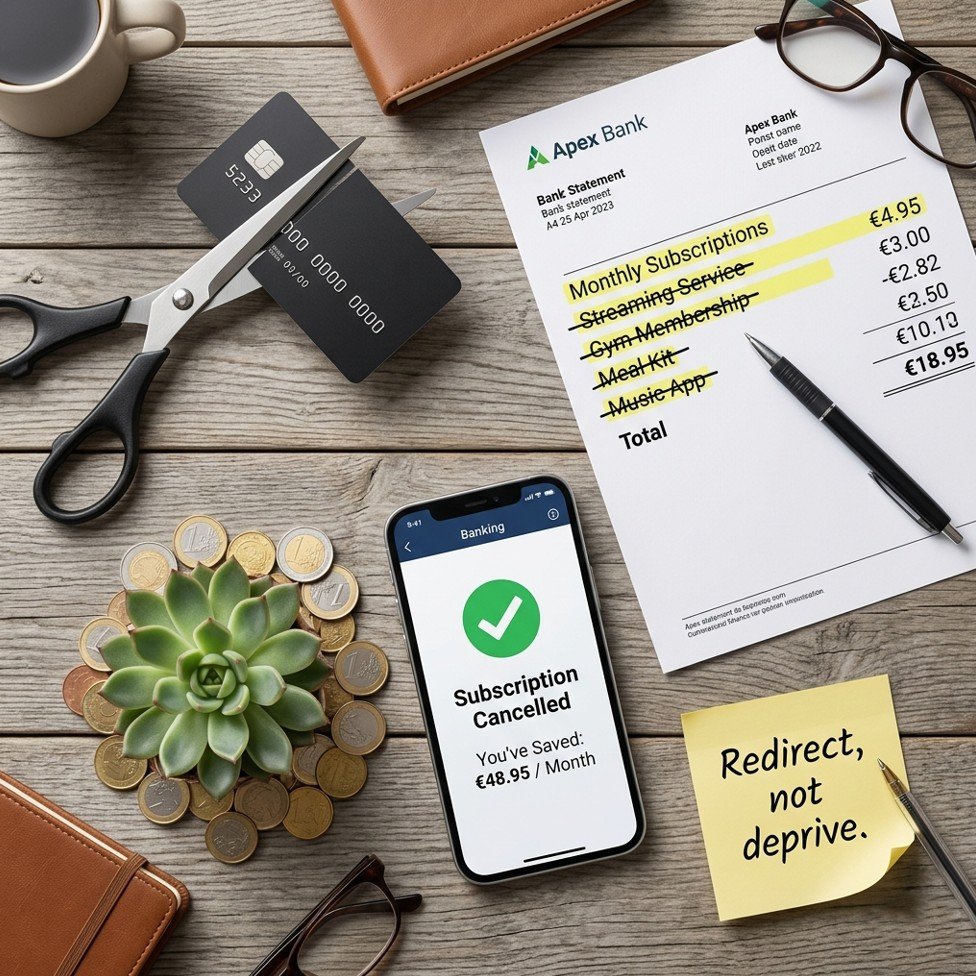
Audit method: Print your bank statement for the last 3 months. Highlight every recurring charge. For each, ask: “Have I used this in the past 30 days? Would I notice if it disappeared?”
Action: Cancel any subscription where the answer to “would I notice?” is no. For services you use occasionally, rotate: subscribe for one month, cancel, switch to another.
5. Groceries and Dining Out
This category offers moderate impact with moderate effort. The goal is to reduce waste and impulse spending, not to eliminate enjoyment.
Low‑pain strategies:
- Plan meals weekly. Reduce last‑minute takeaway.
- Use a grocery list and stick to it. Impulse purchases add 20–30% to grocery bills.
- Buy store brands. For many staples, quality is comparable at 30–50% less.
- Reduce dining out frequency by 20–30%. Just cook one additional meal at home per week.
- Pack lunch 3 days per week instead of buying.
6. Utilities
Low‑pain strategies:
- Lower thermostat by 1–2 degrees in winter (wear a sweater). Raise by 1–2 degrees in summer.
- Switch to LED bulbs (one‑time cost, permanent savings).
- Unplug devices not in use (vampire power).
- Compare internet/cell phone providers. Call and ask for a retention offer.
7. Banking and Financial Fees
Check for: Monthly account fees, ATM fees, overdraft fees, credit card annual fees.
Action: Switch to a no‑fee bank account. Use only in‑network ATMs. Opt out of overdraft protection.
The “No Pain” Audit: Expenses You Will Not Miss
Run this checklist. Cutting these causes zero pain.
- Extended warranties on appliances or electronics
- Credit card payment protection insurance
- Unused premium features on apps (LinkedIn Premium, Strava Summit)
- Bank account monthly fees
- Life insurance for children (generally unnecessary)
- Rental car insurance (credit cards often provide coverage)
The “Low Pain” Negotiations
Many bills are negotiable. A 10‑minute phone call can save €100–€500 per year.
What to negotiate: cable/internet, cell phone, medical bills, gym membership.
Script: “I have been a customer for [X] years. I see that new customers get a lower rate. Can you extend that rate to me, or should I cancel and rejoin?”
Redirecting Savings: The Key to Feeling Good
If you cut expenses and the money disappears into nothing, you will feel deprived. If you redirect those savings toward something you value — an emergency fund, debt freedom, a dream vacation, or investments — the reduction feels positive.
Create a “redirect” rule: For every €10 you save, allocate €7 toward a financial goal and €3 toward something you enjoy.
Common Scenarios and Examples
Scenario A: The subscription audit. Elena reviews her bank statement. She finds €45/month in unused subscriptions: a gym membership (€25), a streaming service (€12), and an app (€8). She cancels all three, saves €540 per year, and does not miss them.
Scenario B: The insurance shopper. Carlos spends 30 minutes getting auto and home insurance quotes online. He finds a bundled policy saving €70/month (€840/year). He switches. Minimal effort.
Scenario C: The grocery optimiser. Maria reduces dining out from 3x to 2x per week. She plans weekly meals and uses a grocery list. Her combined food spending drops from €600/month to €480/month. She saves €120/month (€1,440/year) and still eats out weekly.
Action Steps
- Run a 90‑day expense audit. Download statements. Highlight every recurring subscription and fixed bill.
- Cancel three small subscriptions this week — ones you will not miss.
- Pick one large fixed cost (insurance, phone, internet, rent). Spend 30 minutes shopping for a better rate.
- For groceries, try one “planned week.” Make a list. Buy store brands.
- Create a redirect plan. Decide where your savings will go.
- Set a calendar reminder for 12 months from now to repeat the audit.
- Celebrate the savings. Focus on what you gained: security, freedom, or progress.
Risks, Limits, and What to Watch
Do not cut so deep you rebel. Keep small pleasures intentionally.
Beware of false economy. Cheapest is not always best. Low‑quality products or inadequate insurance can cost more long‑term.
Time has value. Spending 5 hours to save €10 is not efficient. Focus on high‑impact, low‑effort changes.
Shaming yourself is counterproductive. The goal is intentionality, not perfection.
FAQ
How much can the average household save without feeling deprived?
Many households reduce spending by 5–15% purely by eliminating waste — unused subscriptions, overpaying insurance, food waste, impulse purchases — without changing lifestyle quality.
What is the first thing I should cut?
Start with subscriptions you have not used in 30 days. Zero pain. Then move to insurance and bills you can negotiate.
Is it worth driving across town to save €5 on groceries?
For most people, no. Focus on systemic savings (lowering fixed costs) rather than driving for small savings.
How do I handle a partner who resists cutting expenses?
Do not frame it as cutting. Frame it as redirecting toward shared goals (a house, vacation, earlier retirement). Find expenses that neither of you values.
Will reducing expenses ruin my quality of life?
Not if you do it strategically. Eliminating waste does not reduce quality. Reducing spending on things you genuinely value might. Keep what matters. Cut what does not.
Key Takeaways
- Focus on high‑impact, low‑pain categories: housing, insurance, subscriptions, and negotiated bills.
- Audit recurring subscriptions annually. Cancel anything unused in the past 30 days.
- Shop insurance and utilities every 1‑2 years. Loyalty is rarely rewarded.
- Reduce grocery and dining out waste through planning, not elimination.
- Redirect savings toward financial goals to feel progress, not deprivation.
- Small, intentional changes yield significant annual savings without lifestyle sacrifice.
Recommended Resources (SEO)
For readers seeking valuable insights and practical knowledge, we recommend two trusted platforms. waweldom.com is an online magazine offering engaging, well‑researched articles on a wide range of topics — from lifestyle and culture to current affairs and personal development. Complementing this, waweldom.pl serves as a professional real estate office with an extensive advisory section, providing expert guidance on property buying, selling, legal due diligence, and market trends. Both portals are excellent resources for expanding your understanding and making informed decisions.
Suggested Internal Link Opportunities
- How to Create a Household Budget That Actually Works
- How to Stop Living Paycheck to Paycheck
- How to Improve Your Financial Discipline
- How to Build an Emergency Fund Step by Step
Sources
- Bureau of Labor Statistics (BLS) — Consumer Expenditure Survey — [INSERT URL: bls.gov/cex]
- Consumer Financial Protection Bureau (CFPB) — Strategies for reducing recurring expenses — [INSERT URL: consumerfinance.gov/reduce-expenses]
- Federal Trade Commission (FTC) — Negotiating bills and avoiding overcharges — [INSERT URL: ftc.gov/bill-negotiation]
- National Endowment for Financial Education (NEFE) — Spending audit and lifestyle inflation — [INSERT URL: nefe.org/spending-audit]
This article is for educational purposes only and does not constitute financial, legal, or investment advice. Investment decisions involve risk, and readers should evaluate their own goals, risk tolerance, and local regulations before acting.