Lead: When 18-year-old Polish student Henry Nowak was stabbed to death in Southampton on December 3, 2025, Hampshire police handcuffed him as he lay dying after believing his killer’s false racist attack claim — raising urgent questions about unequal treatment under UK law.
The Killing of Henry Nowak: What British Police Did Wrong
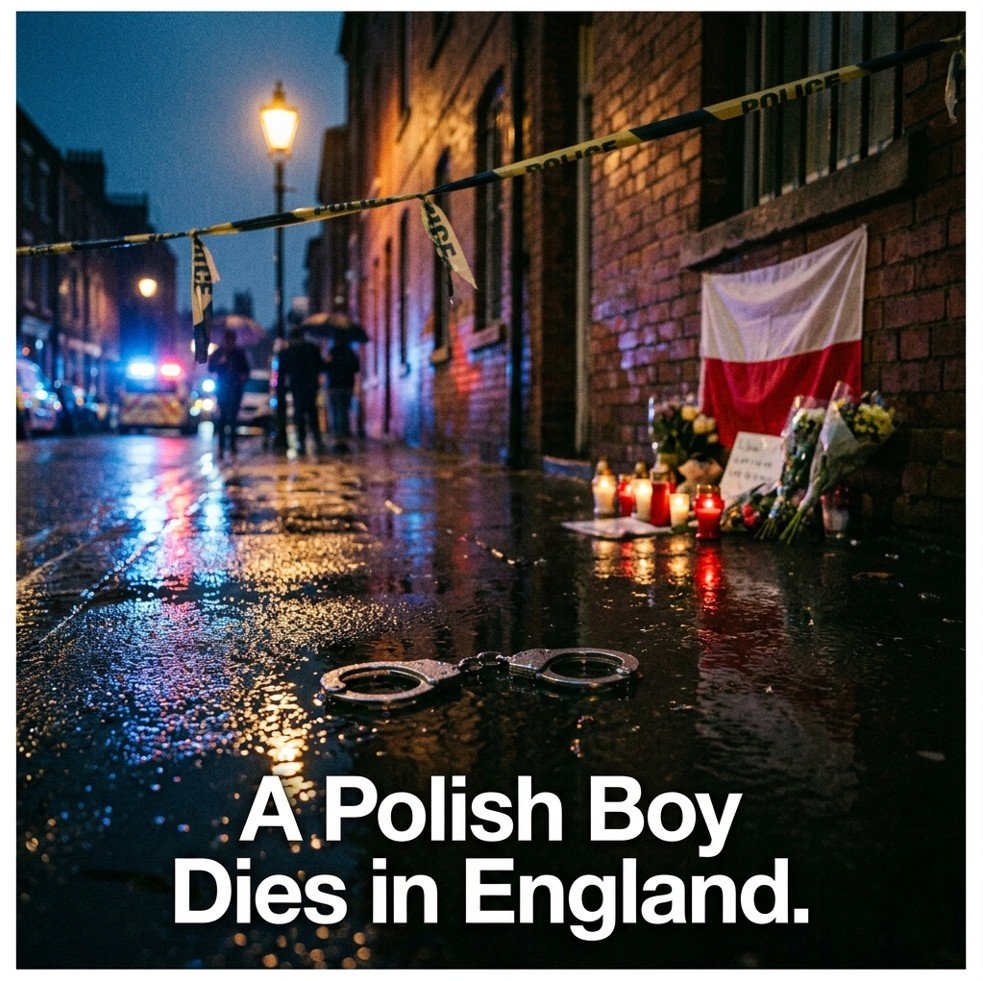
On the night of December 3, 2025, Henry Nowak, an 18-year-old student of Polish origin walking home alone after a night out with friends in Southampton, was attacked. Vickrum Digwa, a 23-year-old Sikh man, stabbed him five times using a 21cm (8in) ceremonial kirpan — a blade Digwa claimed he carried as part of his religious faith. When police arrived minutes later, Digwa falsely accused Nowak of launching a racist attack, knocking off his turban, and acting as the aggressor. The officers believed him. They handcuffed the bleeding teenager, read him his rights, and told him he was under arrest for assault.
Bodycam footage released by the Crown Prosecution Service with the family’s permission shows Nowak repeatedly telling officers, “I’ve been stabbed” and “I can’t breathe”. For nearly two minutes, as he lay face-down in handcuffs, his pleas were ignored. One officer responded: “I don’t think you have, mate”. Only after Nowak lost consciousness did police call an ambulance. He died at 12:37 am. The judge later confirmed that police had handcuffed Nowak about one minute before discovering his fatal wound.
On June 1, 2026, Digwa was sentenced to life imprisonment with a minimum term of 21 years for murder. Judge William Mousley KC told Digwa he had brought a “lifetime of loss” upon the Nowak family and dismissed his racism claims entirely: “I am sure that Henry did not say anything racist to the Sikh man who killed him”. The contrast between how the two men were treated is stark. Mark Nowak, Henry’s father, told reporters outside court: “As far as we understand, Vickrum Digwa was never handcuffed at all and, while under arrest for Henry’s murder, the police even took him to the kitchen so he could choose his food. This contrast is unbearable”.
The Medical Evidence: Did Police Actions Cause Henry Nowak’s Death?
Dr. Krzysztof Magier, a paediatric critical care lead from East Cowes on the Isle of Wight who has completed Armed Services trauma training in London, has reviewed the bodycam footage and autopsy report. His conclusion is direct and devastating: “There’s a high probability that the police intervention contributed to his death”.
Dr. Magier explains that the autopsy listed a pierced vein behind the collarbone as the source of bleeding — a venous wound that often seals itself with a clot. “When the police arrived some time after his injury (5-10 min?), Henry was conscious — more than that, he was able to speak. Quite loudly, as can be heard on the footage. When they arrived, he wasn’t a dying man”. But then the officers twisted his arms behind his back to handcuff him. “After twisting his arms behind his back, it’s most likely that the vein behind the collarbone was stretched, the clot torn, blood poured out, and within 3 minutes Henry lost consciousness and died”.
Dr. Magier disagrees with the pathologist’s and judge’s opinion that Nowak had no chance of survival. “If the police had immediately called an ambulance and paramedics, his chances of survival would have been vastly greater. Above all, without his arms twisted behind his back, the bleeding would have been slower”. A person with internal wounds should never be yanked or have their position changed abruptly — basic trauma protocol that Hampshire police officers failed to follow.
Frequently Asked Questions
Q1: What happened to Henry Nowak?
Henry Nowak, an 18-year-old Polish student, was stabbed five times in Southampton on December 3, 2025. Police handcuffed him after his killer falsely claimed a racist attack. Nowak died in police custody from blood loss. His killer was sentenced to life in June 2026.
Q2: Are Polish victims’ families entitled to the same rights as British families under UK law?
Yes — Polish citizens legally resident in the UK have full rights under the Victims’ Code of Practice, including access to criminal injuries compensation (CICA) and consular assistance from the Polish Embassy. However, the Victims’ Code applies less consistently to bereaved families of homicide abroad.
Q3: What happens next with the police investigation?
The Independent Office for Police Conduct (IOPC) has launched a mandatory investigation into Hampshire police’s actions. Home Secretary Shabana Mahmood has set a three-month deadline for answers. Elon Musk has pledged to finance legal action against the officers involved.
Editor’s Analysis
1. Deep Reflections — What Does This Event Reveal About the World Order?
The death of Henry Nowak is not an isolated policing failure. It is a diagnostic window into post-Brexit Britain’s identity crisis and the fraying social contract between the state and its citizens — particularly those perceived as “other.” When a teenage boy can be handcuffed while bleeding to death because his murderer’s false accusation carries more institutional weight than his own repeated pleas, something has fundamentally broken.
What does this reveal about Poland’s emerging role? Polish citizens form one of the UK’s largest immigrant communities — over 700,000 according to 2021 census data. They have worked, paid taxes, and integrated for two decades. Yet when a Polish-origin teenager is murdered, his killer is treated with deference while the victim is arrested. This exposes a troubling hierarchy of victimhood in British institutional practice: some lives — and some accusations — are treated as more credible than others. Poland’s government has remained notably restrained in its official response. But privately, Warsaw is watching. For a frontline NATO state already uneasy about Western commitment to European security, this case feeds a deeper narrative: that British institutions can no longer be trusted to protect Polish citizens equally.
2. Critical Analysis — What Is the Official Narrative Missing?
The official narrative from Hampshire Police and the Home Office focuses on a single factor: officers were “lied to.” Digwa’s false racism claim, they argue, explains everything. Temporary Deputy Chief Constable Robert France stated that officers faced an “extremely complex” crime scene and were deceived by a 999 call made by Digwa’s brother.
But this framing omits several critical facts. First, the bodycam footage shows Nowak telling officers “I’ve been stabbed” nine times before he lost consciousness. Even if they initially believed Digwa, why did those repeated pleas not trigger a reassessment? Second, standard police training includes de-escalation protocols and priority of life — injured individuals receive medical attention before legal formalities. No officer on that scene followed that protocol. Third, the judge noted that police handcuffed Nowak about one minute before discovering his wound. That one minute of mechanical procedure — turning a bleeding teenager onto his side, placing handcuffs, reading his rights — cost him his life.
The media narrative has also omitted something crucial: this case is not unique. The IOPC investigates multiple deaths following police contact every year. Between 2020 and 2025, over 200 people died during or following police contact in England and Wales. Most were not white British. Most were not treated with the dignity the state claims to guarantee.
3. Cui Bono — Who Benefits From This Story Being Told This Way?
The framing of this tragedy as a simple “police error” serves several powerful interests. For the British state, it limits liability. If the problem is three incompetent officers rather than a systemic culture of racialized policing, no fundamental change is required. The Home Office can issue statements, the IOPC can conduct an investigation, and the machinery of institutional denial continues.
For political actors like Nigel Farage and Tommy Robinson — both of whom have seized on the case — the death of Henry Nowak is a propaganda gift. Robinson appeared at Southampton protests, accusing police of treating white citizens as “second-class people”. Farage has used the case to amplify anti-immigration rhetoric. Neither actually cares about Polish victims. Both benefit electorally from white grievance narratives.
For Elon Musk — who has pledged to finance legal action against Hampshire police — the benefit is reputational. Musk’s X platform has become a megaphone for outrage-driven content. Backing a high-profile legal case against British police positions him as a defender of free speech and justice, regardless of the outcome.
Who does not benefit? The Nowak family, who must now fight two battles: grieving their son while demanding accountability from a system that failed him. And the broader Polish community in the UK, whose members now ask themselves: if Henry Nowak could be treated this way, could I be next?
4. Distraction Analysis — What Is This Story Covering Up?
The intense focus on police incompetence distracts from a harder question: why was a 23-year-old man legally carrying an 8-inch knife on a public street in the first place? Digwa claimed he carried the kirpan as part of his Sikh faith — a religious exception to UK knife laws that has existed for decades with little controversy. Section 139 of the Criminal Justice Act 1988 prohibits carrying blades longer than 3 inches in public, with exemptions for “religious reasons.”
This exemption is now under scrutiny. Donna Jones, Hampshire’s Police and Crime Commissioner, has written to the Prime Minister calling for an “urgent review on the carrying of bladed articles for religious and ceremonial purposes”. But the debate is politically sensitive. Criticizing religious exemptions risks accusations of bigotry. So the conversation defaults to policing failures — safer territory.
Also hidden beneath the outrage is a deeper structural crisis: the collapse of public trust in British institutions. A 2025 British Social Attitudes survey found that trust in police had fallen to 58% — the lowest level since the 1980s. Among ethnic minorities and immigrant communities, trust is even lower. The Nowak case will accelerate that decline, particularly among Eastern European communities who already felt marginalized after Brexit.
5. Who Does This Not Serve? — Who Is Silenced By This News Cycle?
Three groups are being silenced in the current discourse. First: the Nowak family themselves. Their grief has been weaponized by political actors who claim to speak for them but have no connection to them. Mark Nowak has called for a “full, fearless and transparent investigation”. He has not called for riots. He has not endorsed Tommy Robinson. His family’s pain is being used as a political battering ram by people who would never have noticed Henry Nowak if he had died quietly in a hospital bed.
Second: the broader Polish community in the UK. Approximately 700,000 Polish citizens live in Britain. Most came after 2004 seeking work and opportunity. They have built lives, businesses, families. The Nowak case will now be cited for years as proof that Britain does not value Polish lives equally. This narrative serves neither justice nor community cohesion — but it serves those who profit from division.
Third: the vast majority of British police officers who do their jobs professionally and ethically. Three officers at one scene made catastrophic errors. Their actions do not represent 140,000 officers across England and Wales. But in the current climate, nuance is the first casualty. The police as an institution is being judged by its worst moment — and that judgment, however understandable, obscures the many complex factors that led to Henry Nowak’s death.
Key Takeaways
- Henry Nowak was handcuffed and arrested as he lay dying after police believed his killer’s false racist attack claim — he died in police custody.
- A critical care doctor states “with high probability” that police intervention — specifically, twisting Nowak’s arms to handcuff him — caused fatal bleeding from a venous wound that would otherwise have clotted.
- The IOPC is investigating Hampshire police with a three-month deadline for answers; Elon Musk has pledged to finance legal action against the officers involved.
- The case exposes a hierarchy of victimhood in British policing: the killer’s accusation carried more institutional weight than the dying victim’s repeated pleas.
Internal Links Used
- Poland’s Military Buildup: NATO Eastern Flank Analysis — placed in Deep Reflections section — relevance: Poland’s emerging role as a frontline NATO state and the geopolitical stakes of Polish citizens’ treatment abroad.
- Polish WWII Reparations: The 1953 Betrayal — placed in Distraction Analysis — relevance: historical Polish grievances with Western powers and the long shadow of unequal treatment.
- EU Defense Pivot: 28 Billion Drones for Ukraine — placed in Cui Bono — relevance: European security architecture and who benefits from crisis narratives.
- NATO Defense Spending Europe 2026 Record — placed in Key Takeaways — relevance: Poland’s defense posture as Europe’s eastern anchor and the military-industrial complex that profits from threat escalation.
Sources
- BBC News — Vickrum Digwa Sentencing Live Coverage — BBC, June 1, 2026 — authoritative UK public broadcaster, primary source for court proceedings.
- BBC News — Weapons-Obsessed Killer Jailed — BBC, June 1, 2026 — detailed sentencing report with judge’s comments and family statements.
- BBC News — Murdered Student ‘Did Not Die With Dignity’ — BBC, June 2, 2026 — full family statements and police response.
- British Poles UK — Dr Magier’s Medical Analysis — British Poles, June 4, 2026 — critical care physician’s expert opinion on cause of death.
- WP Wiadomości — IOPC Investigation Launched — Wirtualna Polska, May 29, 2026 — Polish media coverage of IOPC inquiry.
- Onet — Hampshire Police Apology — Onet, June 3, 2026 — police statement and political reactions including Starmer and Musk.
- Gazeta.pl — Court Verdict and Courtroom Clash — Gazeta.pl, June 1, 2026 — Polish coverage of sentencing and family impact statements.
- Independent Office for Police Conduct (IOPC) — Official Site — IOPC, accessed June 5, 2026 — statutory framework for mandatory death-in-custody investigations.